


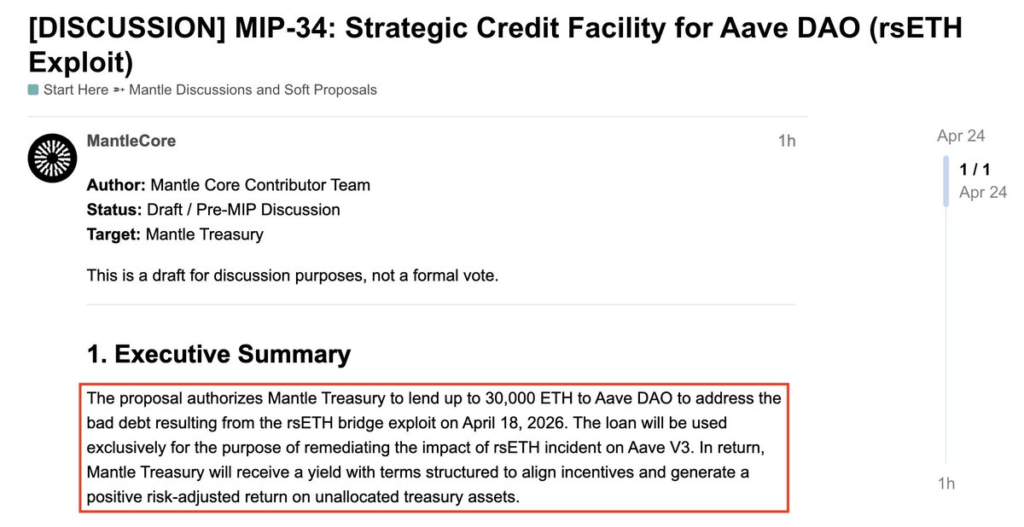
Mantle has submitted a governance proposal to lend up to 30,000 ETH, approximately $69.4 million at current prices, to Aave DAO as part of an industry-wide effort to resolve the bad debt left behind by the April 18 Kelp DAO rsETH bridge exploit.
The Mantle Core Contributor Team filed the MIP-34 on April 24 on the Mantle governance forum, which is open for comments from the community and has yet to go for a Snapshot vote. Mantle has a substantial amount of ETH in its reserves, which gave rise to the loan that allows for the use of its treasury capital.
How the Kelp DAO exploit created Aave’s bad debt problem
The problem arises from the fundamental flaw of Kelp DAO’s cross-chain bridge system. Kelp relied on a 1-of-1 Decentralized Verifier Network (DVN). This is effectively a single-verifier setup where a compromised node can arbitrarily approve citizen messages without further validation checks.
The attacker on April 18 faked a transfer request and alleged a 116,500 rsETH release, which is Kelp’s liquid restaking token from the Ethereum-side bridge, without burning an equivalent amount on the source chain.
The digital assets that were stolen were worth around $292 million at the time, which accounts for a total of 18% of the rsETH’s entire supply that was circulating during that time. Notably, blockchain investigator ZachXBT was among the first to flag the suspicious on-chain activity.
Rather than dumping the stolen tokens, the attacker deposited 89,567 rsETH into Aave V3 as collateral and borrowed approximately $190 million in real assets, primarily WETH and wstETH, across Ethereum and Arbitrum. Aave’s own smart contracts functioned correctly throughout, but the protocol ended up exposed to collateral that had been fraudulently minted upstream.
An incident report co-authored by Aave Labs and risk manager LlamaRisk put potential bad debt at between $123.7 million and $230.1 million, depending on how losses are ultimately distributed.
In the more severe scenario, where damage is isolated to Layer 2 deployments, Mantle’s own WETH lenders face a 71.45% shortfall, a direct financial incentive behind Mantle’s proposal. The exploit is now the largest DeFi hack of 2026, surpassing the April 1 Drift Protocol breach.
Loan terms and the governance catch
Under MIP-34, Mantle Treasury would deploy up to 30,000 ETH exclusively to cover the rsETH shortfall on Aave V3. The loan carries an interest rate of Lido staking yield plus 1% per annum, with a maturity of up to 36 months and optional early repayment with no penalty.
Risk protections include a first-priority lien over all loaned ETH held in a designated multisig, additional collateral comprising 5% of Aave protocol revenue plus AAVE tokens worth no less than $11 million, and delegation of 130,000 AAVE tokens to Mantle for governance participation.
That last condition has attracted scrutiny, as it would hand Mantle, a direct L2 competitor to Arbitrum, a meaningful voting foothold inside Aave’s governance structure at a moment of institutional pressure. Analysts at Crypto Times described the move as less of a bailout and more of an acquisition play.
DeFi United: An industry rallying behind Aave
Mantle’s proposal is the first public commitment with specific figures attached to the broader DeFi United recovery initiative Aave has been coordinating. Aave founder Stani Kulechov has personally pledged 5,000 ETH. The EtherFi Foundation has proposed contributing up to 5,000 ETH through a separate DAO proposal.
Lido has tabled a one-time allocation of up to 2,500 stETH pending governance approval. Golem Foundation and Golem Factory together contributed 1,000 ETH. Ethena, the Ink Foundation, Frax, and LayerZero have each confirmed participation, with LayerZero noting it has been coordinating closely with Aave, EtherFi, Ethena, Arbitrum, and Kelp throughout the process.
Arbitrum’s Security Council separately froze over 30,000 ETH linked to the attacker, cutting the ceiling on unrecoverable losses. However, a portion of stolen funds has already been routed through THORChain, complicating full recovery and increasing urgency around the coordinated commitment drive.
What comes next
MIP-34 is still in pre-vote discussion on the Mantle governance forum. The proposal team has asked community members to assess the risk-return profile and signal support via a forum poll before it advances to a formal vote.
For Aave DAO, the central question is whether Mantle’s governance-linked terms are preferable to drawing down its treasury, which held roughly $181 million at the time of the exploit, or distributing losses directly across depositors.
A source familiar with the recovery effort told Cryptopolitan on April 24 that the situation was nearing conclusion, with official disclosures expected shortly after. Additional DeFi United commitments are still pending announcement, and both Mantle and Aave communities are watching closely as the largest coordinated DeFi debt resolution effort of 2026 moves toward its final shape.


