



Telegram founder Pavel Durov announced on 23 April 2026 that The Open Network (TON) would be dropping its per-transaction fee to a fixed 0.00039 TON, worth about $0.0005 at current prices. This fee would be lowered by a factor of six within the week, regardless of network congestion. Durov noted that the lowering serves as a prelude towards a fully feeless model featuring zero-commission transactions as part of a larger MTONGA roadmap set for development.
A validator-approved fee overhaul
The reduction was formalized through a validator community vote approving a cut in TON’s minimum gas price, the protocol-level floor that determines how little a transaction can cost. The current fee of roughly 0.005 TON will fall to 0.00039 TON once the upgrade activates, representing an 83.3% reduction.
Crucially, the new cost is fixed, so users will no longer encounter fee spikes during high-traffic periods. That predictability matters for the mini-app developers and payment services that form the commercial backbone of Telegram’s crypto ecosystem. Durov shared the update on X, where it drew over 192,000 views within hours.
Step 2 of a seven-part roadmap
The fee cut is the second phase of Durov’s Make TON Great Again (MTONGA) plan, a seven-step upgrade initiative he launched in April 2026. Step 1 was the April 10 deployment of Catchain 2.0, a new consensus mechanism that raised block generation speed sixfold, dropped transaction confirmation times to under one second from over five, and lifted annual network inflation from roughly 0.6% to 3.6%.
The remaining five MTONGA steps have not been disclosed, though TON Pay 2.0 and the TON Teleport Bridge, a Bitcoin cross-chain integration, are already confirmed for mid-2026.
TON would undercut Solana on cost
TON’s current average transfer cost of around $0.00315 already sits above Solana’s $0.00201. Once the MTONGA reduction activates at roughly $0.0005, TON would become approximately 3.5 times cheaper than Solana, a meaningful edge for micro-payment use cases including in-game purchases, NFT trades, and stablecoin transfers inside Telegram.
For developers building monetization models around high-frequency, low-value transactions, that pricing gap can determine whether a product is commercially viable. Analysts are framing the cut as a demand-side catalyst rather than mere cost reduction: lower fees raise the velocity of money through the TON ecosystem, which increases demand for Toncoin as the underlying utility token for every transaction.
A network shaped by turbulence
TON’s present ambitions cannot be separated from its past. The network originated in 2018 as the Telegram Open Network, developed by Durov’s brother Nikolai. In 2020, Telegram shut it down after a bruising settlement with the U.S. Securities and Exchange Commission that saw the company return $1.2 billion to investors and pay an $18.5 million civil penalty.
An independent community revived the codebase under the TON Foundation, and in 2023 Telegram formally adopted TON as its Web3 partner, integrating a native wallet into the app.
The growth was followed by challenges. In the middle of 2024, SlowMist, a blockchain firm, warned about a sharp rise in phishing attacks, which kept spreading in open groups over Telegram. Later, Kaspersky Lab filed a report in early August claiming a pyramid referral scam that has been draining Toncoin off users worldwide since November 2023. In August 2024, two network outages occurred after the DOGS memecoin airdrop overloaded the network’s transaction capacity. These failures enhance the infrastructure priorities, which lie in the design of MTONGA.
On August 24, 2024, Durov was arrested at Paris Le Bourget Airport. This incident was perhaps the most serious. The French authorities charged him with twelve indictments. These include aiding and abetting drug trafficking and distributing child exploitation material. This was over moderation issues with Telegram.
He was released on five million euros bail and remains under judicial supervision and banned from leaving France as of April 2026, which is a risk for an ecosystem that is linked to him.
Market and on-chain context
Heading into the fee cut, TON’s on-chain metrics narrate a tale of caution. December 2024 figures showcased DEX volumes at a $1.4 billion peak, which, as of April 2026, dropped to approximately $26 million. Likewise, DEX’s total value locked dropped from $766 million to approximately $55 million. The price of Toncoin is near the value of $1.40, which is 83% down from its all-time high (ATH) of $8.23 reached in June 2024.
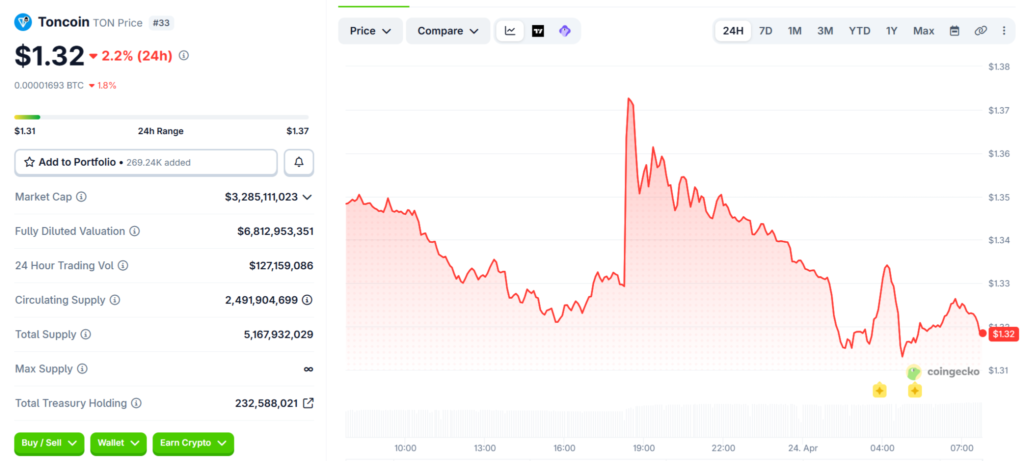
Also, the larger market has not factored in the sustained momentum created by the MTONGA upgrades. The Catchain 2.0 launch did trigger an immediate 5% price jump, a sign that market participants are watching each roadmap step carefully. Whether the fee reduction reverses the volume decline will be the most important test of Durov’s MTONGA thesis.


