


Stablecoins (and cryptocurrencies in general) have quietly transformed the world’s perception of money. As the volatility of digital currency such as Bitcoin has dominated the headlines, stablecoins are slowly emerging as powerhouses due to their inherent stability. In this article, we will explore the top five stablecoin-ready countries right now.
What is a stablecoin?
In the wild world of cryptocurrencies, where prices skyrocket or plummet overnight, stablecoins are those that stand out as the calm anchors in a stormy sea.
Imagine a digital dollar that lives on the blockchain. That’s essentially a stablecoin. In other words, a stablecoin is a type of cryptocurrency engineered to maintain a steady value, typically by being pegged to a stable asset like the U.S. dollar, gold, or a basket of currencies.
As they are tied to fiat currencies such as the US dollar, stablecoins have become the safer alternative to store wealth and perform monetary transactions. For instance, if you consider the stablecoin of the United Arab Emirates, 1 AE coin is equivalent to 1 AED.
Stablecoins essentially came about to solve volatility that comes with cryptocurrency. They are the link between traditional finance and the world of decentralization, giving individuals the ability to conduct transactions, save, or even trade without having to worry about the devaluation of their holdings.
What are the qualities of a “stablecoin-ready” nation?
Before diving into the list, let’s first look at what makes a country stablecoin-ready. Economic instability: Nations with high rates of inflation or currency instability require more stability.
Economic instability: In countries with high levels of inflation or currency instability, there will be an increased need for stability.
Financial system constraints: People use digital forms because they lack access to banks and other traditional financial institutions.
Crypto adoption: Countries with already widespread cryptocurrency adoption also have higher stablecoin adoption.
The Stablecoin Access Index measures how easily people can obtain, use, and move stablecoins across platforms and regions, focusing on availability, liquidity, and user accessibility. It tracks factors like on/off‑ramps, exchange support, and geographic access to show how open or restricted stablecoin usage is worldwide.
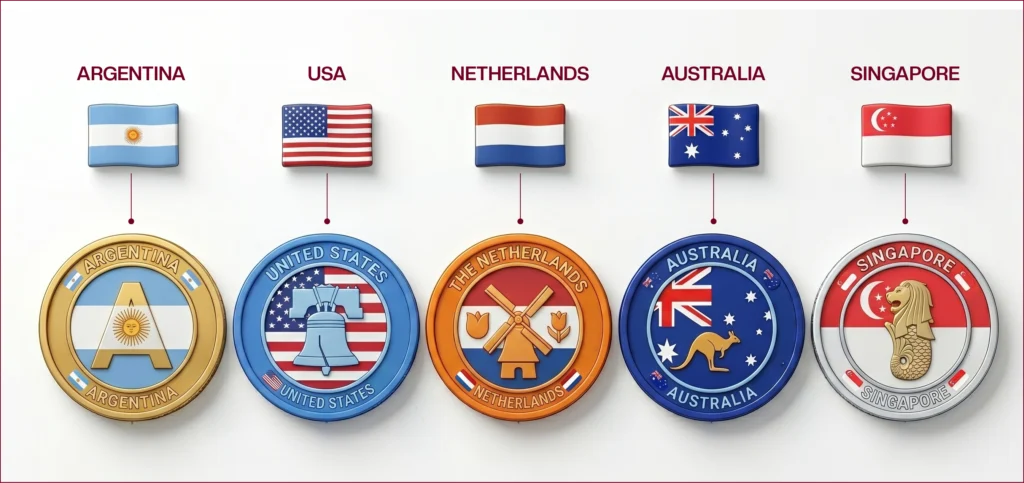
1. Argentina: Stability Through Necessity
The first place on our ranking goes to Argentina, as the country has demonstrated the best readiness level of all other countries on our list, with the indicator amounting to 100%. In most cases, the reasons behind this success are economic rather than technical.
With inflation reaching 33.1% and currency volatility at the level of 16.1% in relation to the US dollar, numerous Argentinians witness daily depreciation of their money. Therefore, US dollar stablecoins become an excellent solution for ensuring financial stability.
Argentina also ranks 20th in the world for crypto adoption, with crypto making up 72.2% of digital payment. This is because Argentinians are no strangers to working with financial alternatives, making stablecoins quite a natural phenomenon within this framework. Indeed, for many people, such coins mean safety rather than speculation.
A study done by DeCard says stablecoins have become a protective means rather than an instrument for speculative gains in Argentina.
2. United States: Infrastructure Meets Innovation
America takes the second place, but not because of economic instability but owing to its impressive financial infrastructure and digital readiness.
In fact, America scores a high 100 Stablecoin Access Score because 97.9% of American adults have access to financial accounts and over 92% know about digital money.
The demand for stablecoins may be lower in America in comparison with Argentina, yet there can be no other country where the technological platform would be more advanced. It appears that Americans feel confident using digital money; thus, their switch to stablecoins would not cause much inconvenience.
What makes America so unique is that it will shape the global stablecoin environment. Most popular coins are pegged to the US dollar. In other words, America is the best example of how stable coin usage may evolve into a convenient way to transact.
3. The Netherlands: Quiet but Efficient Adoption
The Netherlands is the third stablecoin-ready country through its economic stability and increasing involvement in cryptocurrency. Even though the country has an unusually low inflation rate at only 2.4%, stablecoin usage in the country is very evident, with their crypto adoption ranking at 39 and stablecoin transactions amounting to around $2.2 billion annually.
Dutch finance systems are advanced, and banking services are easily accessible. As a result, stablecoins are not needed out of necessity but rather for efficiency purposes. Stablecoins in the Netherlands are great for ensuring quick transactions, low fees, and ease of conducting digital payments.
4. Australia: High Access, Growing Usage
Australia ranks fourth with stablecoin transactions equivalent to those seen in the Netherlands; however, the country is distinguished by its high degree of financial inclusivity.
Australia has $2 billion in yearly stablecoin flows and ranks 38th in the world for crypto usage. Meanwhile, 98.5 percent of the population uses electronic payment systems, and 98 percent of the population has access to financial services. These indicators speak of a population that is highly literate in the field of technology and has a high level of inclusion into the system.
Despite being like the US, Australia is also free from any kind of economic oscillations, but the catch lies in the fast absorption of technology. The bulk of the stablecoins in Australia are used for functional purposes, including foreign exchange transactions and e-commerce
5. Singapore: A Global Crypto Hub
The fifth stablecoin-ready country is Singapore, a country that is very forward-thinking when it comes to finance and technology. It is considered one of the most crypto-friendly countries in Asia and in the world.
In Singapore, 1 in 4 people own cryptocurrency, and around $2.7B worth of stablecoin transactions happen per year. There is 97.8% financial inclusion, and 87.4% of the population uses digital payments.
Argentina uses stablecoins to stabilize its economy, but Singapore adopts the asset due to its innovative and connected nature. It is used as a base for fintech companies.
Regulation is another factor that makes Singapore ideal for adopting stablecoins. Through regulation, Singapore ensures the growth of the asset while keeping its economy stable. Hence, Singapore is well-placed to play a prominent role in the next stage of digital finance.
Stablecoin adoption and why these countries are stablecoin-ready
One of the key takeaways from the DeCard report is that each region has different reasons for stablecoin adoption. While the economies of Argentina and Turkey are using stablecoins as a hedge against their unstable currencies and inflation, the US, Australia and Singapore are using stablecoins for efficiency and development.
It is clear how stablecoins can be flexible with their different use cases and ability to cater to different economies as per their needs. The Stability Readiness Index is particularly interesting as it balances needs with availability. The fact that not all countries on the list suffer from economic difficulties indicates this clearly.
Why stablecoin-ready countries matter right now?
The latest developments in the market environment have reinforced the need for stablecoins. Since cryptocurrencies like Bitcoin witness a decline in value by about one-third within just several months, investors are now looking for a safer currency to invest in.
Stablecoins can be considered intermediate currencies between fiat money and cryptocurrency, because:
– They feature a stable rate of exchange with fiat money
– Enable fast and cheap transfers across international borders
– Provide underprivileged nations with access to the financial system
According to DeCard, the main reason for implementing stablecoins is the protection of purchasing power and gaining access to foreign currency exchanges. Millions of people all around the world find stablecoins to ensure financial freedom and security.
Key takeaways on Stablecoin-Ready Countries
The advent of stablecoin-ready countries implies changes not only in the process of conducting transactions but also in how people use finances and interact with financial institutions.
Argentina shows us the real power of necessity when it comes to technology and the U.S. and Australia show us the power of having the right infrastructure.
Also countries like the Netherlands and Singapore prove that stablecoins can work just fine in places that have political stability and a high level of technology, and maybe that’s why they’re leading the way and are so stablecoin-ready.


