

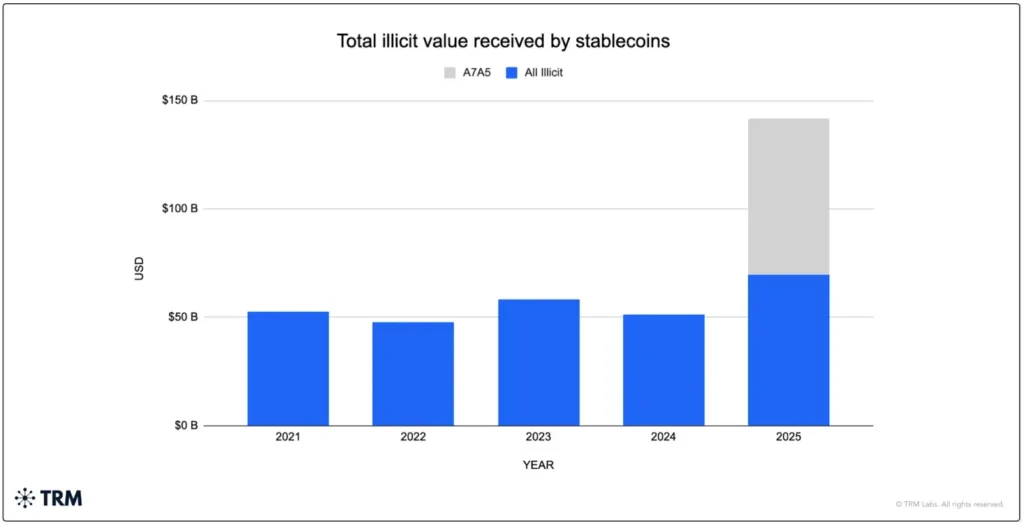
The realm of digital money harbors a shadowy side. In 2025, criminals, sanctioned nations, and trafficking networks quietly moved a record $141 billion through stablecoins—the highest such figure in five years—and most of the world barely noticed.
Blockchain analytics firm TRM Labs dropped this bombshell in a report on Tuesday. However, the firm promptly clarified that this does not indicate a widespread surge in crypto crime. Certain criminal groups now prefer using stablecoins because they offer speed and the ability to dodge traditional banking systems.
Sanctioned Countries Lead the Pack
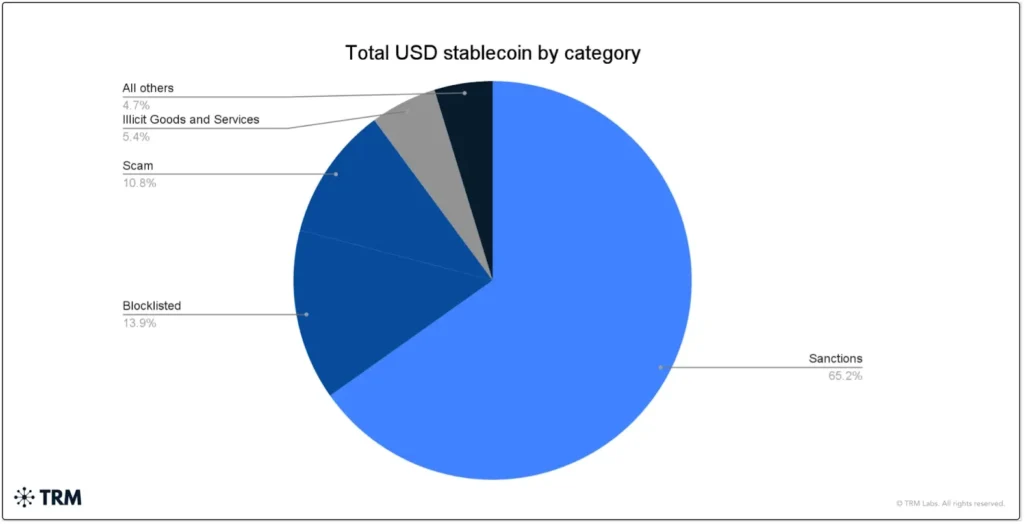
The biggest chunk of this illicit money—a massive 86%—came from sanctions-linked activity. Nearly half of the $141 billion, roughly $72 billion, traced back to a Russian ruble-pegged token called A7A5, which operates almost entirely within networks built to bypass international sanctions.
TRM Labs found that Russian-linked networks connect directly with state-tied ecosystems in China, Iran, North Korea, and Venezuela. Together, these actors used stablecoins as a financial highway to move money far beyond the reach of Western regulators and banks.
The report showed an equally grim picture of other criminal sectors. Human trafficking groups and sellers of illicit goods operated mostly entirely on stablecoins, as they prefer payment certainty over profits. Transaction volumes of underground guarantee marketplaces like Huione were more than $17 billion by late 2025, with stablecoins accounting for 99% of that.
Separately, Chainalysis reported that crypto flows to suspected trafficking networks jumped 85% year-on-year in 2025.
To put this in perspective, TRM Labs estimated that illicit activity accounts for just 1% of total stablecoin transactions. Examining stablecoin volumes and their role across different types of crypto-enabled crime provides a clearer picture of why these instruments have become central to the global crypto economy and why they now sit at the center of regulatory and enforcement debates.