

News has it that Lido DAO is stepping in to support its struggling governance token with a major one-time purchase worth $20 million. It aims to fix what the organization calls a serious and unusual gap between LDO’s current market price and the strong performance of its underlying staking protocol.
Lido DAO (Decentralized Autonomous Organization), in a proposal submitted on Friday, suggested using up to 10,000 Lido Staked Ether (stETH) tokens from its treasury, currently valued at around $20 million, to buy back LDO tokens. The group argues that LDO is trading at historically depressed levels compared to Ether, making it significantly undervalued right now.
“This is not a routine fluctuation. It represents one of the most significant dislocations between LDO’s market price and its underlying protocol fundamentals in the token’s history,” they stated in the proposal.
What is Lido DAO trying to do here?
The organization believes the current discount is not backed by any major drop in how well the protocol is actually performing.
Lido DAO has dominated the Ethereum liquid staking space for years. It currently holds about 23.2% of all staked Ether, according to data from Dune Analytics. Even so, LDO has taken a beating.
The token now trades near $0.30, down roughly 96% from its all-time high of $7.30 set back in August 2021. Its market capitalization is roughly at $255 million.
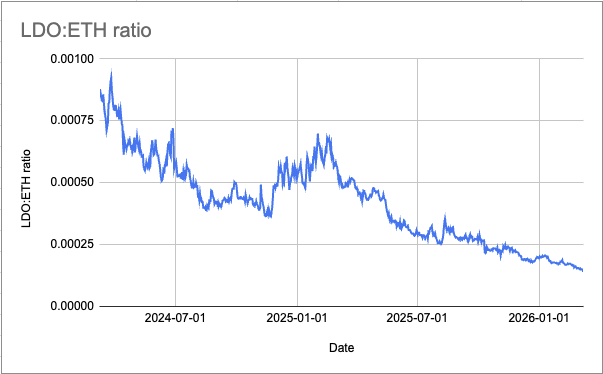
The price of LDO as compared to ETH has fallen sharply since 2024. It’s now trading at a ratio of about 0.00016 ETH per LDO. That puts it roughly 63% below its two-year median level. Lido DAO pointed out that this kind of gap simply does not match the protocol’s real-world results.
Despite the token’s poor performance, the staking service itself continues to lead the market. However, past concerns about Lido’s large share of Ethereum validators raising centralization risks for the network have lingered in industry discussions.
Related efforts in the Ethereum ecosystem, such as proposals for an “economic zone” to reduce fragmentation across layer-2 networks, show the broader push for stronger infrastructure.
Earlier attempts to support LDO have not fully taken off.
In November, one Lido DAO member suggested setting up an automated buyback system for the token to help stabilize its price over time. That idea has yet to be put into action. Now, with LDO sitting at such low levels, Lido DAO is proposing this direct $20 million intervention as a targeted response.
The plan is designed carefully to avoid causing sudden swings in the market. Lido wants to purchase in smaller batches of 1,000 stETH each, up to the full 10,000. For each batch, the organization would use limit orders or a dollar-cost averaging approach. This method spreads out the buying to reduce the impact on LDO’s price during execution.
Significantly, the token holders would be required to approve every single batch before the process continues. After the purchase, the results would be taken back to the community, and they would then be required to seek permission to continue the process to ensure that the community still has full control.
Therefore, if the process is implemented in its entirety, the $20 million buyback program has the potential to take out a lot of tokens out of circulation. The process is estimated to take out up to 8% of the circulating supply, depending on the prices at the time of purchase. This could potentially make the token increase in value at least in the short term.
The proposal arrives at a challenging time for the protocol’s finances.
Lido DAO also reported that its total revenue had fallen by 23% in 2025, recording $40.5 million. The staking fees, which are the primary source of revenue for Lido DAO, also recorded a 23% decline in 2025, recording $37.4 million.
The decline in revenue for Lido DAO was attributed to the overall decline in staking rewards for the Ethereum network as a result of the market correction. However, it is also important to note that the core strengths of Lido DAO remain intact. The rewards for users only declined by 20%, and at the same time, there was an improvement in operational costs by 13% compared to 2024.
More positively, the take rate for Lido DAO, which is the portion of rewards that users receive for staking and that is paid in fees to Lido DAO, increased from 5% to over 6.1%.
This is an indication that the business is improving, despite the fact that it is operating in a difficult market. The take rate is an important metric for understanding whether the business is operating efficiently. The improvement in the take rate is an indication that Lido DAO is improving in terms of business, despite everything.
The buyback proponents believe that this is a clear indication of the organization’s confidence in its own token and the value it holds. In this regard, the organization is putting its money where its mouth is by buying the stETH token with the organization’s treasury funds.
The question that might be asked by the opponents of this buyback is whether this one-time buyback will be enough to make the token appreciate without the overall recovery of the crypto market and the implementation of the previously proposed automated system. The buyback of tokens has been implemented in the traditional financial sector for quite some time now.
The purpose of the buyback is to buy back the organization’s own shares when the management believes that the organization’s shares are undervalued. The buyback of tokens in the crypto market might be beneficial in this regard. The organization that this token belongs to is called the Lido DAO.
The organization has made a name for itself in the crypto sector by becoming the go-to platform for liquid staking on Ethereum. The users of the platform can stake their own Ethereum and receive the stETH token in return.
As Ethereum progresses further with additional layer-2 options and more institutional investors engaging in staking, the competition for Lido DAO also rises. The emergence of exchange-based staking and restaking platforms has resulted in a small loss of market share.
The current proposal focuses solely on addressing the LDO price dislocation rather than changing core protocol operations. It stands separate from any future automated buyback mechanisms that might still be considered.
Community reaction will likely play a big role in whether this idea moves forward. This is because, from the very start, the governance of Lido DAO has always focused on ensuring that there is a high level of transparency and token holder input, as seen in the approval of the buybacks in batches.
If this plan works as expected, it could help to build up some level of confidence in the LDO token and bridge the gap between the token’s value and actual utility. In a time where most crypto projects are having a hard time, this action by Lido DAO is a positive step.