

Bitcoin miner MARA just dropped its Q4 2025 numbers, and while the headline figures look rough, it looks like they are in fact making some adventurous moves that could change the game.
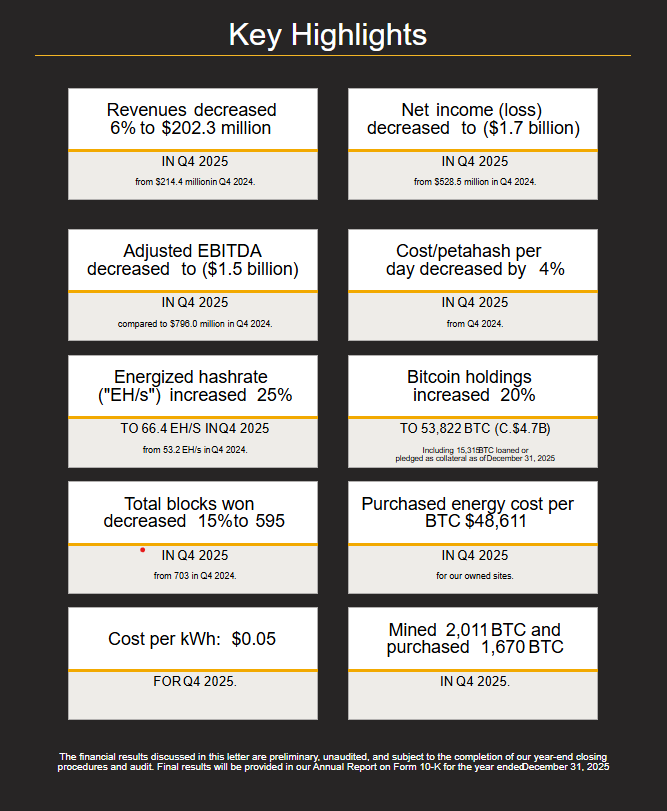
Bitcoin miner MARA reported a hefty net loss of $1.71 billion for the fourth quarter, or $4.52 per diluted share, flipping from a solid net income of $528.3 million ($1.24 per share) in the same period a year ago.
Revenue dipped 6% to $202.3 million from $214.4 million, even as the company ramped up its hashrate. A sharp drop in Bitcoin prices, which dragged down the value of its digital assets by about $1.50 billion as BTC slid from roughly $114,300 at the end of September to around $88,800 by December 31, contributed to this dip.
For the full year 2025, Bitcoin miner MARA posted a net loss of $1.31 billion, compared to a net income of $541 million in 2024. Revenue actually climbed nicely to $907.1 million from $656.4 million the prior year, showing real growth in operations despite the market headwinds.
Production-wise, MARA mined 2,011 BTC in Q4 (down from 2,144 BTC the previous quarter and 2,492 BTC a year earlier), wrapping the year with 8,799 BTC produced versus 9,430 BTC in 2024.
The company closed out 2025 holding 53,822 BTC on its books, including some loaned or pledged, with that stack valued at about $4.7 billion based on the quarter-end spot price of $87,498 per coin. Meanwhile, MARA’s share price has felt the pain, sliding 46% over the past six months amid the broader Bitcoin drawdown.
But Bitcoin miner MARA isn’t just sitting tight.
In its shareholder letter, the company laid out a clear multi-year pivot from being a pure-play Bitcoin miner MARA to a broader energy and digital infrastructure powerhouse.
They’re teaming up with Starwood Digital Ventures on a joint venture to build out AI and high-performance compute (HPC) data centers at their power-rich sites. The initial phase targets over 1 gigawatt of IT capacity, with the potential to scale beyond 2.5 gigawatts down the line.
MARA keeps the flexibility to jump in on up to 50% of projects while still mining Bitcoin where power economics make sense.
They’ve also scooped up a 64% stake in Exaion to chase “sovereign-grade” and enterprise AI opportunities. This hybrid strategy stands out as other big miners wrestle with the same Bitcoin pullback, with some leaning hard into AI leases and others sticking to the classic mine-and-hold playbook.