


Latin America’s fintech giant Nubank is taking a bold leap to integrate dollar-pegged stablecoin payments into its credit card system.
The bank’s Vice-Chairman and former governor of Brazil’s Central Bank Roberto Campos Neto says the move highlights the bank’s ambition to bridge the gap between blockchain innovation and traditional banking.
He said this while addressing the Meridian 2025 conference.
“We’re seeing a shift,” he told attendees.
“People are holding stablecoins as a store of value, not just for transactions. We need to understand this trend and adapt.”
In fact, with over 100 million customers across Brazil, Mexico, and Colombia, Nubank is no stranger to innovation.
Since its inception in São Paulo in 2013, the digital bank has redefined financial access in the region.
Nubank’s crypto journey began in 2022 with a 1% allocation of its net assets to Bitcoin. Then they launched crypto trading for users.
In March 2025, Nubank expanded its offerings, adding Cardano (ADA), Cosmos (ATOM), Near Protocol (NEAR), and Algorand (ALGO) to its platform.
Stablecoin payments across Latin America at all-time high in 2025
Stablecoin adoption has skyrocketed in Latin America. Many attribute this to economic instability and soaring inflation.
In Brazil, stablecoins account for 90% of crypto activity, according to the Central Bank.
Stablecoins like USDt (USDT) and USDC dominate, making up 50% and 22% of crypto purchases in 2024 in Argentina, where inflation has topped 100%.
In Venezuela, where inflation hit 229% in May 2025, USDt is replacing the bolívar in daily transactions like buying groceries and paying salaries.
Meanwhile, according to reports, Bolivia has lifted its carpet crypto ban in 2024 and is now even working with El Salvador alternate stablecoins and Bitcoin with fiat currency.
Across the Latin American region, stablecoins comprised 39% of all crypto transactions.
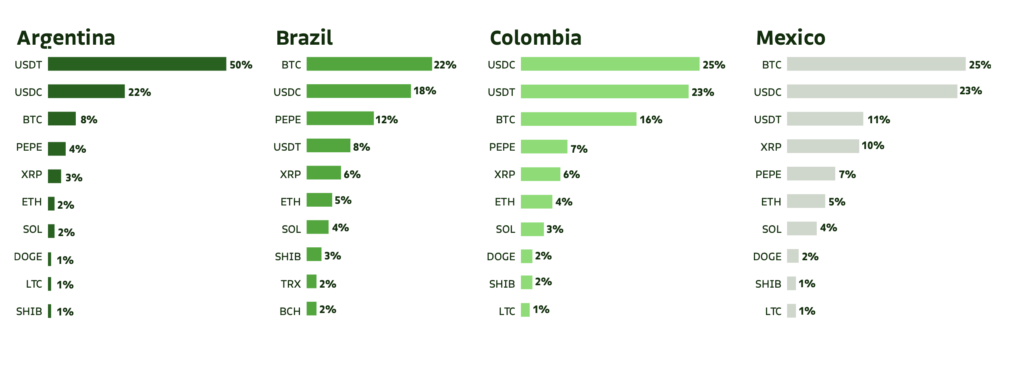
In that sense, these dollar-pegged assets are becoming a lifeline for Latin Americans.
With testing set to begin soon, Nubank is likely to reshape how millions of people pay, save, and interact with money in a rapidly digitizing world.They will also exhibit the growing role of blockchain in connecting digital assets to everyday banking.


