

South Korea’s Ministry of Economy and Finance (MOEF) is taking another meaningful step toward modernizing public finance by preparing to test tokenized deposits for everyday government operational expenses through a new regulatory sandbox focused on distributed ledger technology (DLT).
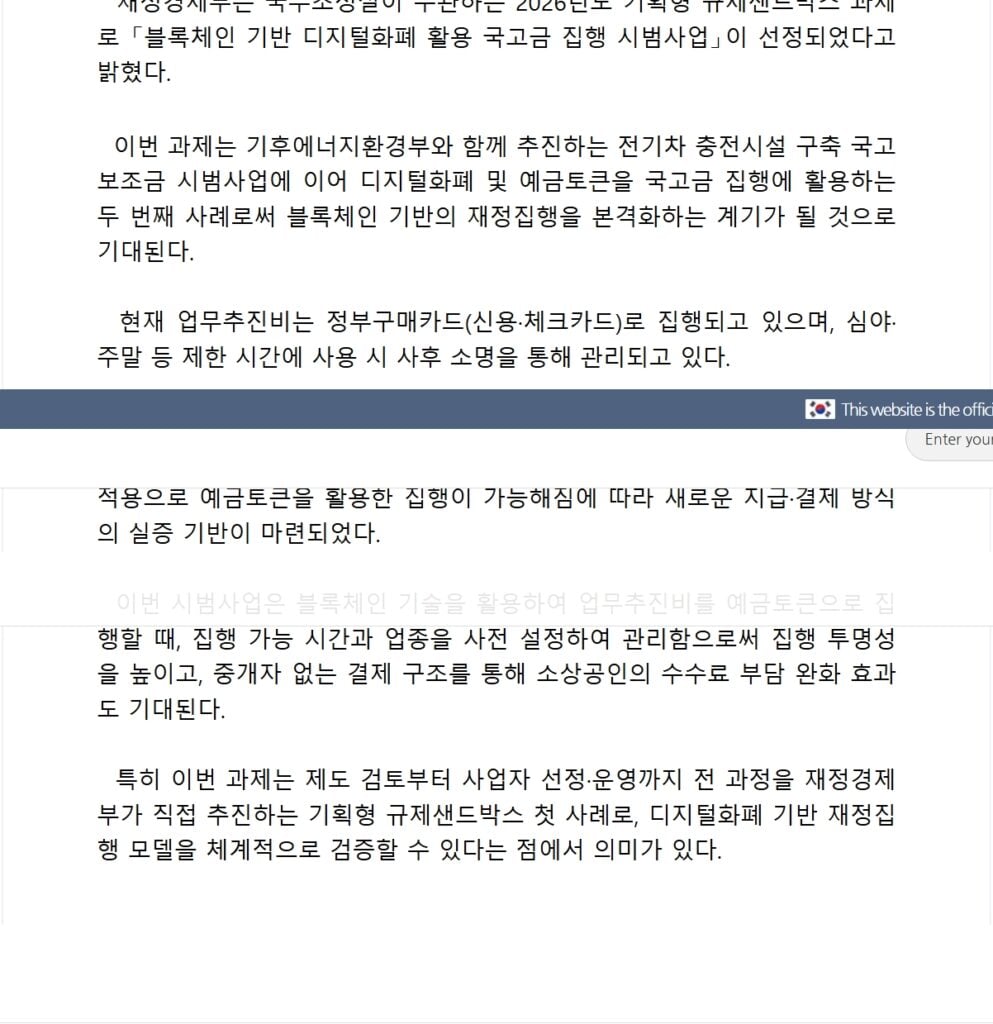
On Thursday, officials announced the selection of a pilot project that will use tokenized deposits to handle selected public spending. The full rollout is targeted for the fourth quarter of 2026, with the initial launch taking place in Sejong City. The experiment will involve certain pre-defined rules on expenditure, such as time constraints and specific purposes for which the money can be spent.
Tokenized deposits are a form of digital representation of bank deposits that have been logged on a blockchain or any other distributed ledger technology platform. The key point about tokenized deposits is that they remain obligations of the bank that issued them, unlike most stablecoins.
How will tokenized deposits work?
What makes this pilot particularly interesting is that it moves South Korea’s tokenized deposits experiment beyond subsidies and into routine government operations. It offers an early real-world test of whether programmable, bank-backed digital money can make public payments more traceable and significantly harder to misuse.
As part of the sandbox, the MOEF will collaborate closely with participating financial institutions to carefully define the scope of the trial. Depending on the results, authorities plan to expand the model and explore necessary legal and regulatory adjustments. Operational expenditure that is currently financed by the issuance of government credit and debit cards, whose reporting takes place after the transaction, is the core of this discussion.
As part of the pilot program, limits to the amount and time frame for the transactions as well as the categories eligible for transactions will be specified ahead of time.
The sandbox approval also provides the flexibility to use tokenized deposits for fund execution, even though current rules typically require processing through traditional government cards.
If successful, the trial could serve as a foundation for evaluating broader innovations in payment and settlement systems. This could have a far-reaching impact on the future fiscal management of South Korea.
This initiative builds on an earlier pilot announced on March 19, in which the MOEF, the Ministry of Environment, and the Bank of Korea agreed to use tokenized deposits for electric vehicle charging infrastructure subsidies. At that time, the ministry expressed its ambition to convert up to one-quarter of all treasury fund executions to digital currency formats by 2030.
The new operational-spending pilot signals a steady, thoughtful expansion of tokenized deposits across public finance. South Korea is becoming a leader in digital payment systems by using both bank accounts and the blockchain network.