
Washington is turning up the heat on prediction markets, and it’s not subtle. In a rare show of cross-aisle agreement, two lawmakers just introduced legislation that would slam the door on members of Congress, the president, the vice president, and other top officials wagering on events they might actually influence, on the basis that powerful insiders could turn classified briefings and closed-door deals into personal windfalls.
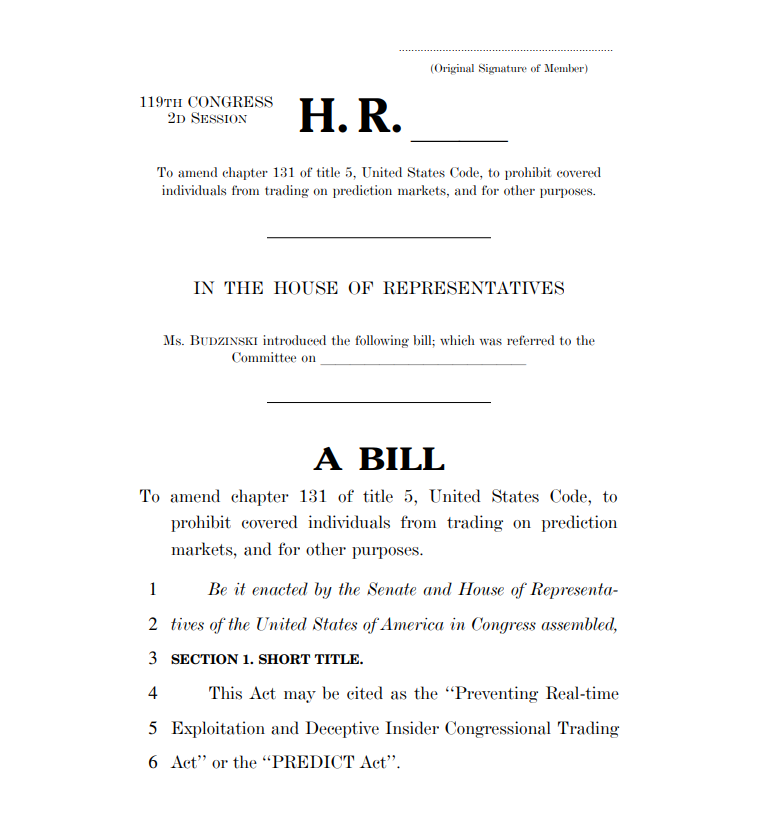
The bill, called the Preventing Real-time Exploitation and Deceptive Insider Congressional Trading Act or PREDICT Act for short, came about thanks to a bipartisan duo: Republican Representative Adrian Smith of Nebraska and Democratic Representative Nikki Budzinski of Illinois. It would explicitly bar these officials, along with their spouses and dependent children, from placing bets on prediction markets involving political outcomes, policy decisions, or any government actions.
“In recent months, we’ve seen instances of little-known traders making massive profits on events ranging from war with Iran to how long a government shutdown will last,” Budzinski said.
“That raises necessary questions about the use of inside information.” She and her co-sponsor want to close every loophole so people with privileged knowledge “cannot profit from it.”
If passed, violations would carry a civil penalty of 10% on the total value of the contract, plus full disgorgement of any profits straight into the U.S. Treasury. It’s a direct response to the explosive growth of platforms like Polymarket and Kalshi, where contracts on everything from election results to geopolitical flashpoints have drawn both huge money and growing suspicion.
This isn’t the only shot being fired at prediction markets. Earlier this month, Democratic lawmakers rolled out the BETS OFF Act, Banning Event Trading on Sensitive Operations and Federal Functions, which takes an even broader swing. It would prohibit bets on wars, terrorism, assassinations, and any event where someone in power might know or control the outcome.
Senator Chris Murphy pointed to suspicious trading patterns around President Donald Trump’s military moves involving Iran, arguing that prediction markets were ripe for exploitation by those with insider edges.
The Wider Backlash Against Prediction Markets
The scrutiny isn’t limited to political betting. Sports-related contracts have also caught fire at both federal and state levels. Just this week, Senators John Curtis and Adam Schiff introduced their own bipartisan measure aimed at stopping CFTC-registered platforms from listing contracts that look suspiciously like sports bets or casino-style games.
They argue that many of these offerings are “indistinguishable from gambling,” and they slammed the Commodity Futures Trading Commission for what they see as a sudden about-face on long-standing rules against gaming-related contracts.
Eleven states have already taken legal action against prediction markets, with two more teeing up similar moves. Platforms have responded quickly; both Kalshi and Polymarket recently tightened their rules to block professional athletes and political candidates from betting on their own events or related outcomes. It’s a clear attempt to get ahead of regulators and rebuild trust.
Prediction markets have exploded in popularity precisely because they aggregate crowd wisdom on real-world events in real time, often with startling accuracy. Supporters say they provide valuable signals that traditional polls or pundits miss. Critics counter that when the bettors include (or have access to) the very people shaping those events, the whole system starts to smell.
According to Budzinski, Americans are fed up with politicians using their influence for personal gain, and the rise of prediction markets has made those worries impossible to ignore. The PREDICT Act isn’t trying to kill the industry outright. Rather, it will focus on protecting public trust by keeping the most powerful players on the sidelines.
Whether these bills gain real traction in a divided Congress is anyone’s guess, but the momentum is unmistakable. From suspicious wins on Iran strikes to bets on domestic policy drama, prediction markets have moved from niche crypto curiosities to front-page political head-aches.
Lawmakers on both sides now seem to feel that if you’re inside the room where decisions happen, you shouldn’t be allowed to bet on what comes next.
At its heart, this push reflects deeper questions about fairness, transparency, and what happens when information asymmetry meets easy digital betting. As prediction markets mature and attract bigger money, expect the regulatory battles to intensify.