


The EU central bank has thrown its weight behind a forward-looking plan to strengthen supervision of the crypto sector across Europe. Accordingly, the European Central Bank (ECB) backed the European Commission’s proposal to place oversight of significant crypto companies under the EU’s unified financial markets regulator.
This move shows how they view digital assets, aiming for greater consistency and stability in a fast-growing market. The EU central bank published its opinion on Friday, expressing full endorsement for shifting responsibility for systemically important cross-border players, including large trading platforms and crypto firms to the European Securities and Markets Authority (ESMA).
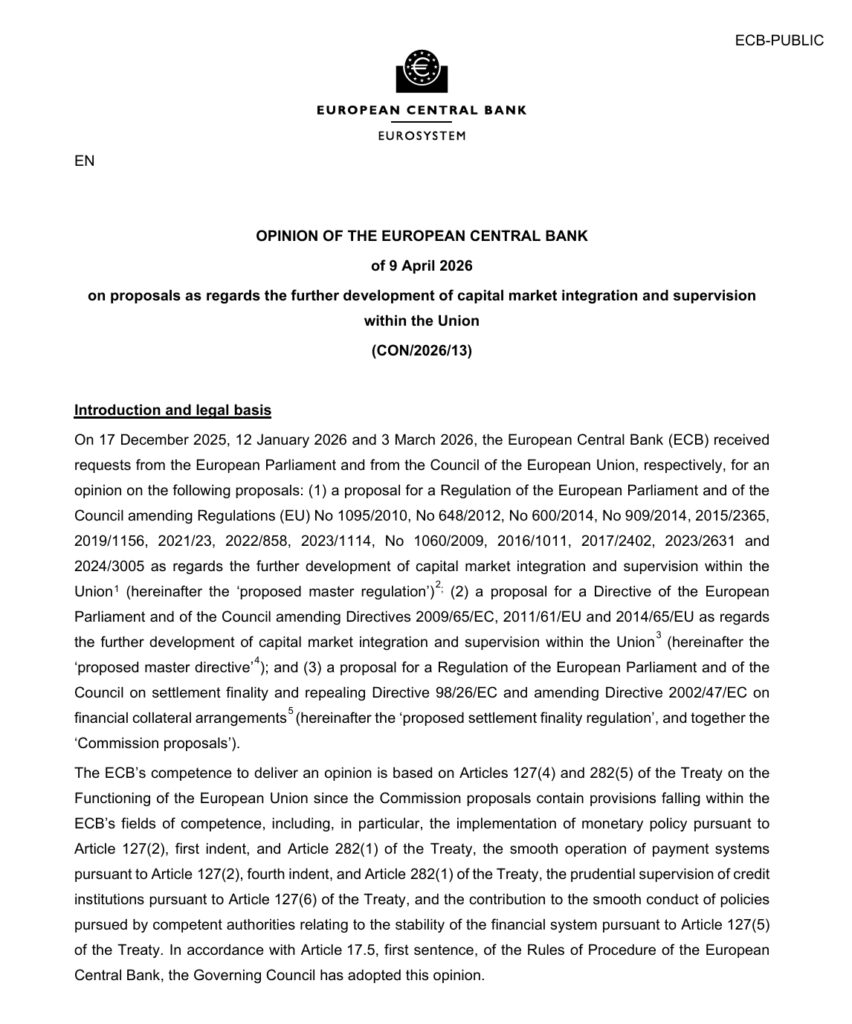
Officials at the EU central bank described the proposals as “an ambitious step towards deeper integration of capital markets and financial market supervision within the Union.”
While the opinion itself is non-binding, it provides valuable momentum to rules since the Markets in Crypto-Assets (MiCA) framework began rolling out in mid-2023.
Under the current MiCA rules, crypto-asset service providers (CASPs) can obtain a license in one EU member state and then operate across the entire single market. ESMA sets broader standards, but day-to-day supervision stays with national authorities.
This setup has encouraged some firms to choose jurisdictions perceived as more welcoming: Kraken established its EU base in Ireland, Coinbase and Bitstamp opted for Luxembourg, and Bitpanda chose Austria for one arm and Germany for another. Even popular hubs like Malta have seen strong activity.
However, the EU central bank argues that the time has come for a more unified approach. If supervision for all CASPs were transferred to ESMA from national competent authorities in respect of authorization, monitoring, and enforcement issues, this would go a long way in ensuring supervisory convergence and reducing fragmentation.
In the view of the EU central bank, this centralized model would support overall financial stability and protect the integrity of the single market. Another important issue brought up by the EU central bank is that of increased interdependence between banking and crypto sectors.
Cryptocurrency services may be provided by banks to their clients or through collaboration with cryptocurrency companies, who can introduce volatility to the general financial sector through the cryptocurrency market. It is necessary to establish a centralized union supervisory system for CASPs that can manage risks presented by CASPs that engage in cross-border operations.
The EU central bank emphasizes practical realities
In order for ESMA to perform its functions efficiently, it must have enough money and manpower. Without the necessary support, the advantages of having central control may be difficult to achieve. In this respect, the bank recommended implementing the process in stages to avoid any interruptions while making the changeover.
Although the plan still faces months of discussion among EU lawmakers and member states before potentially becoming law, the endorsement from the EU central bank adds considerable credibility. It implies that both entities have a mutual agreement about the importance of efficient regulation within EU standards as the cryptocurrency market continues to grow and develop and integrate with the mainstream economy.
The EU’s approach signals its readiness to build a fiercely competitive, yet safeguarded, digital finance ecosystem. By collaborating with ESMA, the EU aims to curb regulatory arbitrage, encouraging innovation while maintaining security. This could lead to greater transparency concerning the practices of cryptocurrency companies in the years to come.