

Imagine crypto wallets quietly moving millions while deadly chemical shipments cross oceans, feeding into the ruthless machinery of fentanyl trafficking? Well, that’s exactly what happened according to a federal indictment in Ohio, where authorities have caught two Chinese pharmaceutical companies and six individuals accused of playing a key role in the global supply chain.
A federal grand jury in Dayton handed down charges against Shandong Believe Chemical Company Pte Ltd. and Shandong Ranhang Biotechnology Co. Ltd., along with six Chinese nationals: Hanson Zhao, Gao Yanpeng, Xia Yi, Zhang Jian, Wang Zhaolan, and Zhang Chunhai.
Prosecutors allege the group supplied critical precursors and cutting agents specifically designed to manufacture and stretch fentanyl for street-level distribution across the United States and beyond. Customers were reportedly directed to pay using cryptocurrency wallets controlled by the defendants, turning digital assets into a convenient pipeline for laundering the profits.
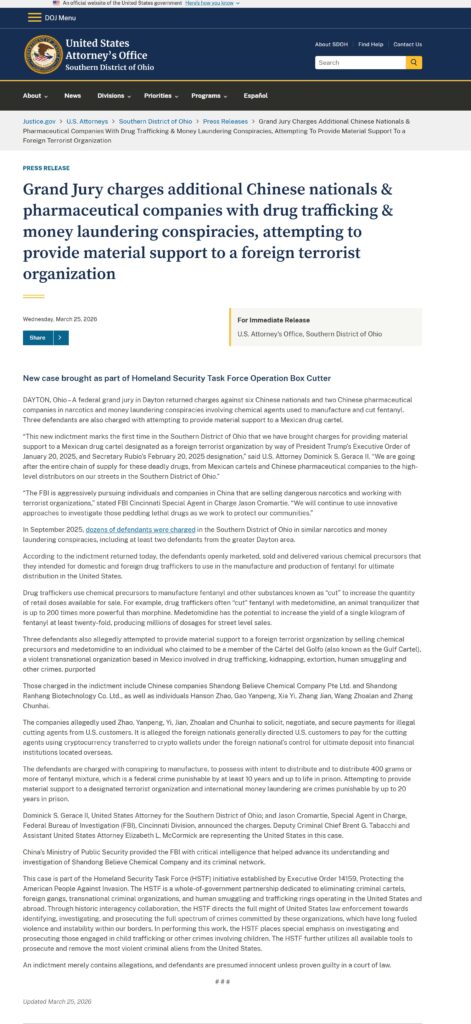
This case falls under the FBI’s Operation Box Cutter, a coordinated push to rip apart international fentanyl trafficking networks at every level. Three of the defendants face additional charges for allegedly attempting to provide material support to a Mexican drug cartel, the Gulf Cartel, which has been designated a foreign terrorist organization.
That escalation shows just how intertwined chemical suppliers, cartels, and modern payment methods have become in today’s fentanyl trafficking landscape. According to the indictment, the companies openly marketed substances like medetomidine, an animal tranquilizer that’s become a popular cutting agent. Mix it in, and suddenly one kilogram of fentanyl can be diluted and expanded to produce at least 20 times the original volume.
Think about that for a second: millions of potentially lethal street doses from a single shipment. These weren’t accidental sales. The materials were allegedly intended for drug traffickers operating right here in the U.S. and abroad, directly feeding into fentanyl trafficking operations that have devastated communities from coast to coast.
If convicted, the defendants are looking at some of the harshest penalties on the books, like up to life in prison on the drug trafficking counts, plus another 20 years or more for money laundering and the terrorism-related charges.
The Crypto Connection in Fentanyl Trafficking
What makes this indictment hit differently is the central role of cryptocurrency in greasing the wheels of fentanyl trafficking. Investigators say customers were instructed to send payments to specific wallets under the defendants’ control. From there, the funds were layered through chains of pass-through addresses before being converted back into fiat currency and funneled into overseas banks.
As blockchain analytics firm TRM Labs noted in a recent report tied to the case, this “layering pattern” starts with stablecoins landing at an initial collection point, then gets fragmented and shuffled before exiting the crypto world.
It’s sophisticated, hard to trace in real time, and increasingly common. Research from TRM highlights how deeply embedded crypto has become: roughly 97% of China-based drug precursor manufacturers reportedly accept these digital payments. On-chain inflows to such vendors climbed to $39.1 million in 2025, building on steady growth from previous years.
This incident apparently isn’t isolated. It also shows a major shift in enforcement strategy in the U.S that targets the entire ecosystem of fentanyl trafficking, from foreign chemical suppliers and payment facilitators to the distributors moving product on American streets.
U.S. Attorney Dominick S. Gerace II said, “We are going after the entire chain of supply for these deadly drugs, from Mexican cartels and Chinese pharmaceutical companies to the high-level distributors on our streets in the Southern District of Ohio.”
The human cost of fentanyl trafficking is impossible to ignore.
This synthetic opioid has flooded markets because it’s cheap to produce, insanely potent, and easy to hide. A small amount can kill, and when mixed with other drugs or made into fake pills, it turns fun use into a deadly game.
Every new link in the supply chain that comes to light, like these supposed Chinese suppliers, gives us another chance to stop the flow before more people die.
Operation Box Cutter also shows that countries are working together more. Reports say that China’s Ministry of Public Security gave the FBI useful information, which is a sign that diplomatic pressure and working together are starting to work, even though the problem is still huge.
There are still problems, though. Those involved in the fentanyl trade favor cryptocurrency. The appeal lies in its speed and the level of privacy it affords, surpassing conventional banking methods. But tools like blockchain analysis are getting better at finding patterns that were hard to see before.
As law enforcement steps up its efforts against upstream players, expect more cases like this one. They will go after not only the cartels that make the final product but also everyone who helps it get from the lab to the street.
This Ohio indictment for fentanyl trafficking makes it clear that no part of the world is off-limits when it comes to keeping people safe from this synthetic drug.