




Think about how you could turn things like bonds, funds, and real estate into digital tokens that can be traded right away, settle in seconds, and cut costs all around. That’s the exciting vision that is getting a lot of attention right now, thanks to strong signals from Australia’s central bank.
In a standout move this week, the Reserve Bank of Australia showed support for the real-world asset (RWA) tokenization sector, highlighting analysis that points to a potential annual boost of 24 billion Australian dollars, or $16.7 billion, for the national economy.
Australia’s central bank isn’t just dipping a toe in the water anymore.
Assistant Governor Brad Jones laid out the findings from Project Acacia on Wednesday, describing tokenized finance and the infrastructure upgrades that come with it as nothing short of “revolutionary.”
He emphasized that the potential gains for the Australian economy from RWA tokenization sit right around that $16.7 billion mark each year, with even bigger possibilities if entirely new markets take shape as a result.
“First, we no longer see the main question as whether tokenization has a future in Australia’s financial system, but rather, how,” Jones noted.
That simple shift in framing speaks volumes. It shows how Australia’s central bank has moved past the skepticism phase and into practical planning mode, building on earlier explorations of central bank digital currency concepts.
The momentum feels electric. Global consulting firm McKinsey & Company has projected that the broader value of tokenized assets could approach nearly $2 trillion by 2030. Closer to home, the head of Australia’s securities regulator, Joe Longo, urged the country back in November to “seize the opportunity” or risk falling behind in this fast-evolving space.
Project Acacia was a joint effort between the RBA, the Digital Finance Cooperative Research Centre, and other industry players to find out if tokenized assets could really make Australia’s wholesale financial markets work better. It tried out about 20 different use cases, from government and corporate bonds to repos and investment funds. It also tried out different ways to settle, such as using tokenized money.
Australia’s central bank is now taking concrete next steps to turn these insights into action. Jones announced plans for the RBA to partner with other agencies and industry groups on a fresh “digital financial market infrastructure (DFMI) sandbox.”
This is designed as a longer-term, stage-gated environment where everyone can safely test and scale tokenized money, assets, and supporting systems. Think of it as a controlled playground that smooths the road to real-world implementation, potentially linking up with a wholesale central bank digital currency down the line.
Particular areas of interest include how wholesale CBDC might interact with bank deposit tokens and stablecoins, plus the synchronization of tokenized asset ledgers with the existing Reserve Bank Information and Transfer System (RITS). Jones added that stablecoins and bank deposit tokens could play complementary roles rather than competing directly, with each suiting different market segments. This kind of thoughtful integration could reduce risks, speed up settlements, and unlock liquidity in ways that feel almost futuristic today.
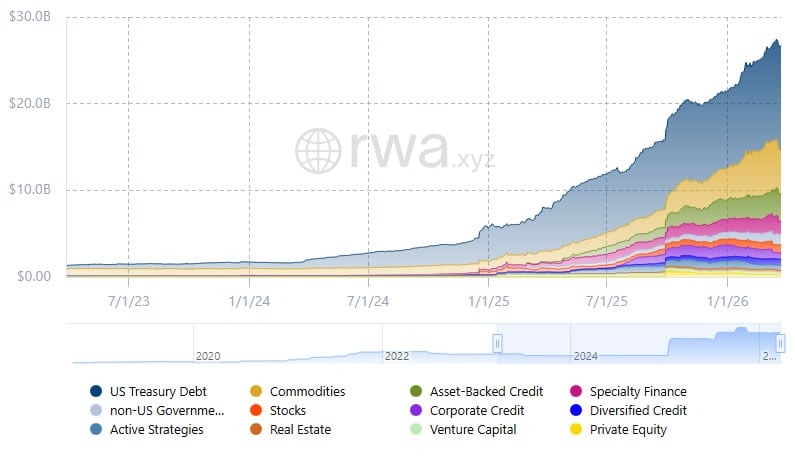
The broader RWA sector has been on a tear, with onchain value (excluding stablecoins) hitting a record high of around $27.5 billion recently, according to data from RWA.xyz. That’s despite choppy conditions in the wider crypto market; the sector has surged an impressive 234% over the past 12 months. Explosive growth like that highlights why Australia’s central bank sees this as a strategic priority: ensuring the country’s payments, monetary, and financial infrastructure stay “fit for purpose” in the digital age.
Of course, challenges remain
Legal and regulatory hurdles need addressing, coordination across the industry is key, and network effects will determine how quickly adoption scales.
That’s exactly why the RBA is also looking at forming a Regulator-Industry Tokenisation Advisory Group and expanding work on deposit tokens. Major players, including pension funds, are already showing interest in crypto and tokenized offerings amid rising demand from investors.
For Australia, this means setting up the economy to take advantage of actual efficiency gains such as reduced counterparty risks, quicker settlements, lower transaction costs, and access to new capital sources. If the $16.7 billion annual upside (and possibly more) comes to pass, it could have a knock-on effect on markets, helping businesses, institutions, and eventually regular Australians by creating a more robust, contemporary financial system.
The message from Australia’s central bank is that the future of tokenized assets is a practical opportunity waiting to be built, one careful, collaborative step at a time.