

- Who was Chris Larsen? How did his philosophy about working with banks shape Ripple’s strategy?
- Why did Larsen see cross-border payments as a problem worth solving?
- Why did most banks adopt RippleNet but avoid using XRP directly?
- How does Larsen differ from many crypto leaders?
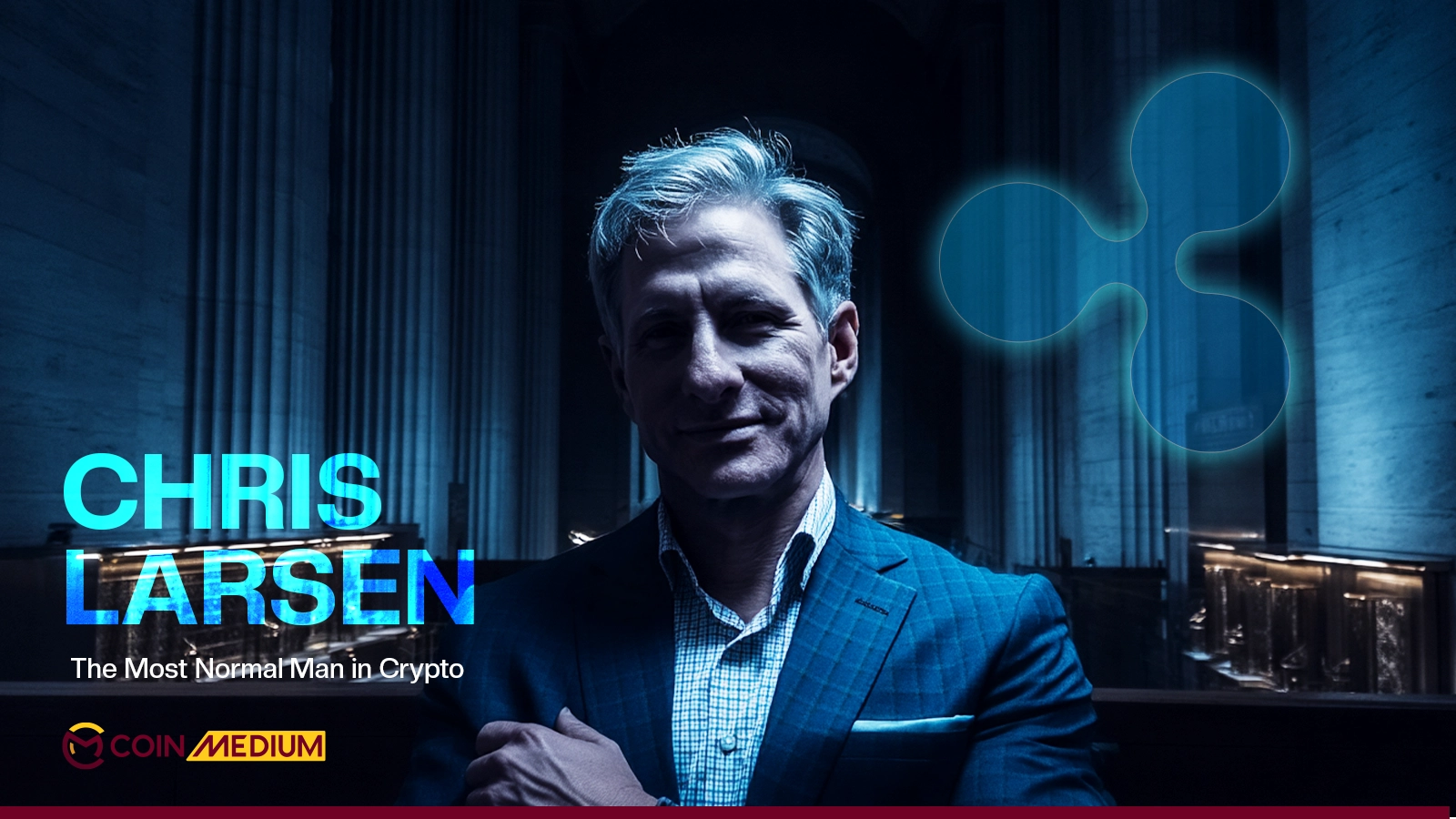
If you passed by Chris Larsen on the street, you may not be able to guess that he made his fortune in crypto. He drives a modest car, supports Democrats, and at 65 has the look of a person who has spent his entire life inside a boardroom.
In the crypto industry, appearances like this are rare.
But Larsen controls billions of XRP tokens and runs Ripple, one of the few crypto companies that convinced traditional banks to test its technology. His fortune has swung from about billions of dollars to a fraction of that and back to it again. He has survived a big legal brawl with the U.S. Securities and Exchange Commission (SEC) that could have killed his company.
What’s more, he has always been trying to prove something most crypto people gave up on: crypto companies can work with banks instead of destroying them.
The Guy Who Hated Banks Before Bitcoin Existed
Larsen grew up in San Francisco. After grabbing his Stanford business degree in 1984, he launched E-LOAN from his garage in 1996. Via this company, he tried providing a solution to a rampant problem: banks charging whatever they wanted for mortgages because people could not compare rates. His website let them shop around. Wall Street hated it. Customers loved it. The company went public in 1999, and Larsen made his first fortune: roughly $400 million.
He started another innovative venture in 2006 with Prosper, America’s first peer-to-peer lending marketplace that tried cutting banks out entirely. Regulators tried their best to curtail it, and Prosper spent years fighting to stay alive.
Then 2008 happened. Larsen watched Lehman Brothers collapse and the government bail out the same banks that had fought his companies. He saw something else: when financial panic hit, moving money between countries became nearly impossible. Wire transfers that normally took three days took two weeks. “The system’s broken at its core,” he told friends.
Why Larsen Started Ripple
When Larsen discovered Bitcoin in 2011, he thought it had a flaw: Bitcoin wanted to replace banks. That meant banks would fight it forever. Apart from this, he found another real problem worth solving. Moving money across borders relied on SWIFT, a messaging system from 1973 that just told banks to move money, but it didn’t actually move anything. A wire from New York to Thailand might bounce through four banks. Each took a cut. Each added delay. At that point in time, the World Bank estimated that people paid $600 billion a year in cross-border transaction fees.
In 2012, Larsen co-founded the company OpenCoin (later renamed Ripple Labs and now Ripple) with programmer Jed McCaleb. The underlying XRP Ledger technology had been developed starting in 2011 by Jed McCaleb, David Schwartz, and Arthur Britto, with the ledger launching in June 2012. Larsen joined shortly thereafter to help commercialize it.
The team pre-mined all 100 billion XRP tokens at inception. Of these, 80 billion XRP (80%) were gifted to the newly formed company (OpenCoin/Ripple) to support development, ecosystem growth, and adoption—particularly for use in fast, low-cost cross-border payments as an alternative to systems like SWIFT. The remaining 20% was allocated among the founders and early contributors.
Ripple initially held the large majority of XRP and has since placed most of it into escrow for controlled monthly releases to promote stability and predictable supply.
The Pitch That Did and Did Not Work
To promote Ripple and XRP, Larsen traveled extensively—to cities like London, Tokyo, and New York—pitching bankers on efficiency rather than revolution: “You’re losing money on every international wire. We can cut your costs significantly and settle instantly.”
By late 2017, over 100 financial institutions had joined RippleNet, a global payment network connecting banks, payment providers, and institutions for faster, cheaper cross-border transactions, often using XRP as a bridge currency for liquidity.
Santander launched a blockchain-powered international payments app (One Pay FX) using Ripple technology. American Express partnered with Ripple for faster cross-border business payments. SBI Holdings in Japan led a consortium of 61 banks that developed the Ripple-powered MoneyTap app. MoneyGram signed deals starting in 2018 to pilot and later use XRP for settlements.
But Larsen faced a challenge he could not discuss publicly: most banks tested or adopted RippleNet without using XRP. They embraced the messaging infrastructure for instant settlement and features SWIFT lacked. But the cryptocurrency itself? Traditional banks steered clear, wary of regulatory hurdles and the need to justify price volatility to shareholders and overseers.
Banks selectively adopted Ripple’s technology, favoring the infrastructure while avoiding XRP itself. Ripple could not prominently highlight this disconnect. To retail investors, the narrative emphasized growing bank partnerships and the potential for XRP in payments, with headlines amplifying “institutional adoption” stories that helped drive price rallies.
What Ripple’s marketing materials did not say was that the banks are testing the network but avoiding the cryptocurrency that people are buying. Ripple kept selling XRP to fund its operations, that too lots of it.
Things Kept Swinging Always
In December 2017, XRP traded at $0.25. By January 4, 2018, it hit $3.84. Larsen’s net worth exploded to $59 billion, briefly making him richer than Mark Zuckerberg. But he kept a low profile and did not buy fancy things like a yacht. Instead, he donated $25 million in XRP to San Francisco State University and gave millions to environmental causes.
Then XRP crashed to $0.26 by September 2018, down 93%. Why? Retail investors realized they had bought a hype. Larsen’s paper fortune evaporated. By late 2018, he was worth around $8 billion, down by $51 billion in just a few months. What’s more, regulators started asking questions about Ripple’s practices.
The SEC had been monitoring Ripple’s activities for several years. The formal investigation intensified around 2018, culminating in the lawsuit filed on December 22, 2020, against Ripple Labs, CEO Brad Garlinghouse, and Larsen.
The SEC’s charges against Larsen were brutal: Between 2013 and 2020, he dumped billions of XRP tokens on public exchanges, walking away with at least $450 million. He fully understood that Ripple was selling the dream—pushing XRP as a token whose value hinged entirely on the company’s relentless efforts to build demand and utility. He played the frontman, appearing in slick promotional videos and interviews, pumping XRP’s bright future. He kept unloading his holdings even as the SEC’s probe closed in. And not a single one of those personal sales was ever registered as a securities offering.
The SEC based its entire case on the Howey Test—a 1946 Supreme Court bombshell from SEC v. W.J. Howey Co. that spells out what makes something a security: four simple but deadly prongs—(1) you put in money, (2) into a common enterprise, (3) expecting profits, (4) that come mainly from the sweat of someone else. In the agency’s view, XRP checked every box: buyers were flat-out gambling that Ripple’s nonstop popularity would raise the token’s price. That turned certain XRP sales into unregistered securities, plain and simple.
The lawsuit triggered instant panic. In the days following the December 22, 2020 announcement, XRP plunged over 60%—from around $0.50 to lows near $0.20. Coinbase soon announced it would suspend XRP trading. Binance.US fully delisted it. Larsen’s paper net worth cratered, dropping from an estimated $8–10 billion to roughly $3–4 billion.
Most companies in Ripple’s position would have cut a quick settlement. Larsen, Garlinghouse, and Ripple chose to fight.
Why Larsen Went to War
Larsen was livid over what he called blatant SEC hypocrisy. For years, agency officials had declared Bitcoin and Ether non-securities because their networks were “sufficiently decentralized.” Yet Ethereum still has a powerful foundation and a celebrity founder—Vitalik Buterin—whose tweets alone can swing the market. To Larsen, how was that any different from Ripple and XRP?
Plus, the SEC never gave clear guidance. They could have told Ripple years earlier to stop selling XRP or register it. Instead, they stayed silent for years, then sued for past conduct.
Larsen had battled regulators before while running Prosper, and he had learned that a solid position and top-tier lawyers could force a fair fight. So the team brought in Paul, Weiss—the firm that had shielded big banks during the 2008 meltdown. He did so despite knowing that his legal tab would eventually end up being millions of dollars.
The case dragged on for two and a half years. Ripple’s lawyers forced the SEC to hand over internal documents that revealed that the agency’s analysis was inconsistent and contradictory.
On July 13, 2023, Judge Analisa Torres delivered her verdict. Larsen walked away clean. All charges were dismissed. The SEC could not prove that he knew his sales violated securities law. No fines. No penalties. His $450 million in XRP sales was untouchable.
Ripple’s victory was not as desired but still massive. Torres ruled that programmatic XRP sales on public exchanges were not securities offerings: retail buyers were simply trading a digital asset in blind transactions, with no direct tie to Ripple’s efforts or promises, no reasonable expectation of profits from the company, and no identifiable “investment contract.”
However, institutional sales presented a distinct scenario. Direct deals to hedge funds and VCs came with pitch decks, lock-up periods, and explicit promises of Ripple’s work to build demand through bank partnerships and RippleNet growth. Those qualified as unregistered securities.
XRP’s price exploded post-ruling, roughly doubling from $0.47 to peaks near $0.95. In August 2024, Ripple settled with the SEC for a $125 million penalty—far less than the SEC’s $2 billion demand. Both sides dropped their appeals by mid-2025. As of January 2026, XRP is around $2.20–$2.30, and Larsen’s net worth is estimated to be in the $10–15 billion range as institutional investors pour money into newly launched XRP ETFs.
What Actually Happened to the Initial Dream?
Over the years, Ripple has developed partnerships with over 300 banks and financial institutions worldwide. The company has facilitated tens of billions in cross-border payment volume across more than 55 countries.
But most banks still use RippleNet without XRP. Santander’s app? And the Japanese banks? All of them tested it but have not used XRP. Therefore, the idea of XRP replacing SWIFT remains largely theoretical.
Currently, Larsen lives peacefully in San Francisco. He has donated over $100 million to political causes, mostly Democrats, and mostly for climate change. This positions him as somewhat of an outlier in the more libertarian-leaning segments of the crypto community.
He built his fortune by disrupting traditional financial institutions, then spent years engaging and partnering with them. He advocates for blockchain and decentralization while personally holding around 2.5 billion XRP tokens.
He backs political figures who favor clearer cryptocurrency regulations, even as Ripple has fought high-profile legal battles, including against the SEC.
“If you want to change the world, you work with the one that exists,” he said in 2019. “Bitcoin people want banks to die. Fine. I want them to work better.”
At 65, Larsen remains deeply engaged in his vision. He continues dialogues with central banks and regulators, emphasizing that global money transfers should not cost $20–50 on average and take days to settle.
Some say he is crypto’s most practical visionary. Others call him a good salesman. Some people hope that he will eventually resolve the problems with international payments, possibly within the next 10 years.
Whatever may be true, he has changed the conversations. He proved banks could try blockchain. He showed crypto companies could fight regulators and win. He demonstrated that one can get massively rich in crypto without acting bizarre on Twitter.
The quiet guy from San Francisco keeps on building. The price keeps swinging. The banks keep testing. And Larsen keeps betting his fortune that someday, somehow, things will actually work the way he said they would.