

- What exactly is Proof of History, and how is it different from Proof of Work or Proof of Stake?
- Why did Solana need Proof of History?
- How does the “decentralized clock” concept prevent disputes about transaction order?
- What are the limitations or risks of Proof of History?
- Can other blockchains adopt Proof of History?
Anatoly Yakovenko, a Ukrainian-American computer scientist and entrepreneur best known as the co-founder and CEO of Solana Labs, was having his coffee in his San Diego apartment in 2017 when an idea struck him. The former Qualcomm engineer had been wrestling with blockchain’s biggest headache—getting thousands of computers worldwide to agree on when transactions happen without the need for a central authority. While having his coffee, Yakovenko came up with an idea that is now known as Proof of History. Most people outside of crypto have not heard of it, but thanks to the concept, thousands of transactions are processed on the Solana blockchain at high speed.
To understand Proof of History, it is essential to know why it was needed. Cryptocurrency transactions face a natural challenge: how do blockchain networks spread across the world agree on when exactly transactions occur when nobody is running the show?
Picture a classroom with no teacher. Many students are arguing about who answered which question first. Everyone remembers things differently. There is no referee to settle this. Decentralized networks face the same mess when there is no central server to timestamp transaction occurrences.
Bitcoin solves this through Proof of Work and the mempool concept. Miners compete to solve math puzzles; the winner organizes transactions (depending on which pays the highest transaction fee) and adds them to the blockchain. This works fine but has a minor hiccup: on average, seven transactions occur per second, which is quite slow.
Ethereum solves the chaos through Proof of Stake. Validators lock up their cryptocurrency as collateral (the “stake” part). The network randomly selects validators to verify new blocks (with the amount they have staked being one factor for selection). Once a validator is selected, they can add a new block, and the Ethereum protocol automatically creates new ETH as a reward. In this process, too, the same hiccup is seen: it manages 15-30 transactions per second.
To address the problem of slow speed, Yakovenko developed the concept of Proof of History. In November 2017, he released a white paper introducing Proof of History to the world. It was hailed as a breakthrough method that enables a blockchain to create its own verifiable and tamper-proof timeline using nothing more than a continuous chain of cryptographic hashes.
The innovation, described by Yakovenko as “a decentralized clock no one can turn back,” solved the long-standing problem of ordering transactions without constant network monitoring, and it became the foundational technology powering the Solana blockchain, which Yakovenko co-founded, after the development of Proof of History.
Rather than computers endlessly debating when events occurred, Proof of History creates a verifiable record of the passage of time between events. Think of someone photographing a newspaper every day. The newspaper’s date proves when each photo was taken. There is no need to trust the photographer, as the dated newspaper does the job.
How the Technology Functions
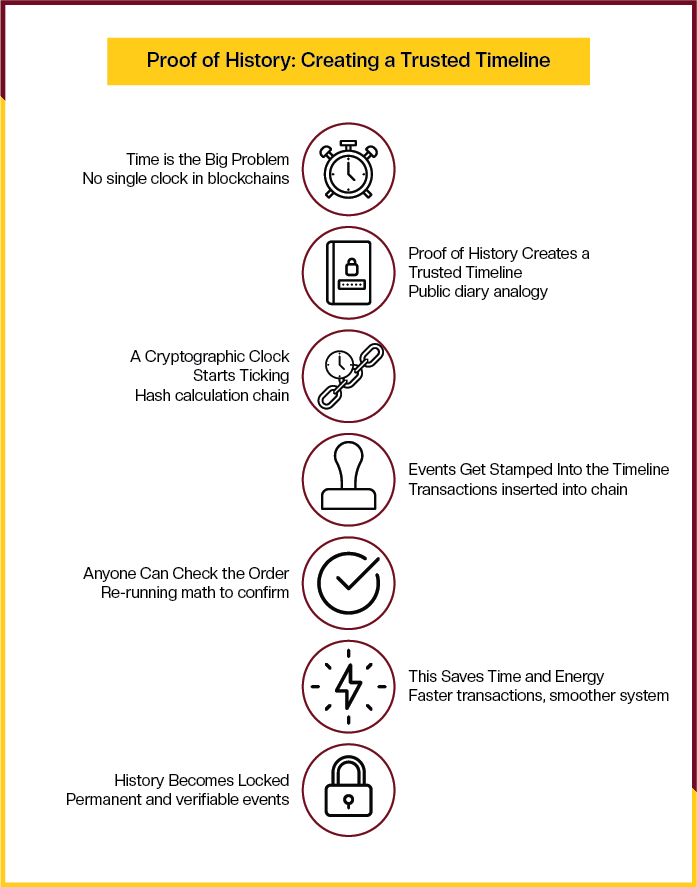
The technical core of Proof of History involves something called a Verifiable Delay Function. The network is always doing a cryptographic calculation, and the output of one becomes the input for the next. It makes a chain that cannot be broken, with each step taking a certain amount of time to finish.
To understand this, picture 1000 dominoes standing in a queue. It takes exactly one second for each one to fall and knock over the next. This shows that 1,000 seconds have passed by since the first domino fell. Nobody has to watch every single domino to verify the time when each one fell.
Proof of History uses a high-frequency verifiable-delay function—millions of sequential SHA-256 hashes—to produce a long, unbreakable chain of numbers that acts as a decentralized clock. Every transaction is assigned a specific position in this chain and given a unique sequence number.
Anyone can later prove, using pure math, that transaction A happened strictly before transaction B just by comparing their places in the chain—no coordinators, no voting, no debates about timing.
In simple terms, any blockchain using Proof of History has an in-built tamper-proof cryptic feature (just like a clock) that ticks thousands of times per second. This clock does not use seconds or minutes. It just spits out a never-ending list of numbers:
…1234567 → 1234568 → 1234569 → 1234570…
Every new number contains solid proof that the previous one really came first and that a tiny slice of real time passed. No one can fake it, and no one can jump ahead
To answer a question like, “Did Alice pay Bob before or after the price crashed?”, the Solana blockchain cryptic feature looks at the number on both their transactions: If Alice’s payment is at tick 1234568, and the crash got recorded at tick 1299000, then the math says Alice paid first. Case closed, and no debate is required.
Why Timestamping Matters
Traditional blockchains rely on a chaotic mempool where miners or validators can pick, and often do, reorder, delay, or front-run transactions for profit. Proof of History largely eliminates this mess by providing the network a built-in, cryptographically provable timeline. Once published, no one can credibly claim a different order — the clock can’t be rewound or fast-forwarded. So, a blockchain using Proof of History does not need the same kind of easily manipulable mempool that Bitcoin and Ethereum have.
Convinced that the concept of Proof of History was too big to stay a side project, Yakovenko quit his job, recruited his old Qualcomm colleague Raj Gokal, and together they turned that single breakthrough into a new blockchain called Solana. It was launched in 2020 with Proof of History beating at its core.
Solana also uses Proof of Stake, but adding Proof of History timestamps into its system changed everything about the transaction speed.
Traditional Proof of Stake networks waste a lot of time and computing power just sorting transaction orders. Every validator receives transactions at slightly different moments depending on the internet connection and location. This requires communicating back and forth, comparing notes, and voting on which transaction came first. This coordination eats up a lot of time.
Proof of History timestamps cut through most of this coordination. A transaction shows up with a Proof of History timestamp already baked in—no debate about when it happened or where it belongs in the sequence. The timestamp is cryptographically verifiable.
A popular restaurant is a good example to understand things better. Traditional blockchain is like everyone crowding into the restaurant, arguing about who arrived first and who gets served next. Proof of History is the ticket machine at the restaurant, stamping each person with a number as soon as they walk in. No arguments happen after this.

Solana stays fast despite using Proof of Stake because validators can focus on confirming transactions are legitimate rather than wasting time arguing about their sequence. Pre-timestamped transactions allow validators to process batches of transactions simultaneously rather than waiting for everyone to agree on the order in which they should be processed. Less back-and-forth between validators means more transactions get handled per second.
The timestamps help validators join the network faster. They can verify the entire transaction history without asking other validators about event order—the timestamps provide that proof on their own.
It is important to understand that Proof of History is not a replacement for Proof of Work or Proof of Stake. It works alongside traditional consensus methods. A courtroom is the best way to think about it. Proof of History is the tamper-proof evidence everyone trusts. Proof of Stake is the jury making decisions. The clock ensures everyone agrees when the evidence was presented and the jury delivers the verdict. Neither works properly without the other.
Right now, Solana is the only major blockchain using Proof of History. And this setup explains Solana’s speed. The blockchain can theoretically handle 65,000 transactions per second, though real performance usually sits at several thousand. Bitcoin manages only seven. Ethereum handles fifteen to thirty.
No other blockchain has implemented Proof of History successfully despite it being an open source. Its technical demands are substantial. Running Proof of History requires powerful hardware capable of high-speed continuous cryptographic calculations. Most blockchain projects cannot afford to build this from scratch. Moreover, they are committed to different architectures that would be nearly impossible to retrofit.
Real Benefits and Real Problems
Industry observers lament that the benefits of Proof of History are limited to Solana, as the speed it provides means much more than impressive numbers. Solana transactions cost fractions of a penny versus several dollars on Ethereum when the network is busy. It also makes microtransactions viable and enables applications that were not economically feasible before.
Thanks to Proof of History, decentralized finance platforms execute complicated trading strategies in milliseconds. NFT marketplaces handle massive traffic spikes without collapsing, and many blockchain games run smoothly. Use cases that seemed impossible a few years back are now a reality.
Critics have reasons to be worried. Critics have reasons to be worried. The hardware required for doing Proof of History is out of the reach of ordinary people, which means fewer validators are available for Solana as compared to other blockchains. Moreover, when only the wealthy entities can validate, the network becomes more centralized and prone to attacks.
Furthermore, Solana has faced many technical issues that totally halted operations. The worst one was in September 2021, with the network staying offline for 17 hours. Another one came in January 2022, lasting for about 18 hours. Critics say these are examples of how chasing speed creates fragility. But supporters say these are mere growing pains.
Security researchers continue to examine whether the cryptographic assumptions underlying Proof of History are sound for the long term. No major vulnerabilities have emerged yet, but the technology has not endured the decade-plus of battle-testing that Bitcoin’s Proof of Work has survived.
Proof of History represents one path for blockchain scalability. As cryptocurrency matures past pure speculation into genuine utility, innovations like this matter more, as nobody waits several minutes for transactions to confirm while buying coffee, trading stocks, or playing video games.
It remains to be seen if other blockchains will use similar methods. Solana’s implementation is both a technical success and an ongoing experiment that pushes the limits while maintaining security levels at an acceptable level. The next few years will show if Proof of History becomes an industry standard or stays the unique calling card of one ambitious blockchain project.