If you have spent any time around crypto or blockchain development, you’ve probably heard the same complaints repeated over and over. Ethereum is powerful, but it can be slow. Gas fees jump and the network gets congested when activity increases. As a result, transactions get delayed, and scaling usually means adding more layers on top.
That reality is one of the reasons newer Layer 1 blockchains keep showing up. Monad is one of those newer projects. It doesn’t get as much hype as some others, but it has been quietly attracting attention, mostly because of how it approaches performance rather than what it promises.
Instead of saying Ethereum is broken, Monad starts from a different assumption which is “Ethereum works, but the way transactions are executed can be improved”.
This piece is meant to explain Monad without getting too technical or promotional.
So, What Is Monad Exactly?
At a basic level, Monad is a Layer 1 blockchain that supports the Ethereum Virtual Machine (EVM). That might sound like marketing language, but it has a very practical implication.
If something runs on Ethereum today, it can usually run on Monad with little or no modification.
That includes smart contracts written in Solidity, common developer tools, and the wallets people already use. For developers, this matters more than flashy performance numbers. It means they don’t have to relearn everything just to experiment on a new network.
The goal with Monad isn’t to replace Ethereum. It’s closer to offering another base layer that behaves like Ethereum but executes transactions more efficiently.
Why Monad Exists in the First Place
Most blockchains process transactions in order. One goes in, finishes, and then the next one starts. It is simple, and it works, but it also creates a hard limit on how much activity a network can handle. When usage increases, that limit shows up fast. Fees rise, confirmations slow down, networks get congested, and users start looking for alternatives.
Monad was built to address this specific issue. Instead of stacking scaling solutions on top, the idea is to improve execution at the base layer itself.
Whether that approach wins long term is still an open question, but the motivation behind it is pretty straightforward.
How Monad Actually Handles Transactions
One of the main ideas behind Monad is parallel execution.
In reality, many transactions don’t touch the same data. Monad takes advantage of that by executing non-conflicting transactions at the same time instead of forcing them into a single queue. That alone allows more work to happen per block.
On top of that, Monad uses a fast consensus setup that keeps block times short and confirmation delays low. This doesn’t change how developers write contracts, but it changes how quickly things feel like they are happening.
There’s also a custom execution engine underneath. It still supports Ethereum smart contracts, but it’s optimized for how computation and memory are handled during execution. Most users will never see this part directly, but it’s where a lot of the performance gains come from.
Developer Experience (Which Is Honestly the Point)
A lot of blockchains fail not because the tech is bad, but because developers don’t want to deal with new tooling, new languages, or new mental models.
Monad avoids that problem by leaning into EVM compatibility. Solidity works. Existing libraries work. Wallets work. Infrastructure doesn’t need to be reinvented.
This makes it easier for teams to test ideas or deploy applications without committing fully to a new ecosystem. In practice, that flexibility matters more than theoretical throughput numbers.
The MON Token, Briefly
Monad has a native token called MON. It is used for transaction fees and for staking, which is how validators participate in securing the network. Validators lock up MON to produce blocks and take part in consensus.
Like most Layer 1 tokens, MON is also expected to play a governance role over time, although how that evolves will depend on how the network matures.
What People Are Building on Monad
Monad is not designed for a single niche. It supports the same broad categories of applications you see on Ethereum: DeFi, trading platforms, games, NFTs, and consumer-facing apps.
Where it tries to stand out is in use cases that need frequent interaction. Trading, gaming mechanics, and applications that feel sluggish on slower networks tend to benefit most from faster execution.
That’s the theory, at least. The real test is how these applications behave once usage scales.
Top dApps to Explore on Monad
Looking at live decentralised applications usually tells you more than documentation does. Even though Monad is still early, a few projects already stand out:
Curvance
Curvance operates as a DeFi lending protocol where users can supply and borrow assets. On Monad, the experience feels more responsive, particularly around position updates and liquidations, which are often slow on congested networks.
Kuru
Kuru is a decentralized exchange focused on simple token swaps. It is the type of application where network performance becomes obvious during busy periods, and faster execution helps trades settle more smoothly.
Monorail
Monorail takes an aggregation approach rather than acting as a single exchange. By routing trades across multiple liquidity sources, it aims to improve pricing, and higher throughput helps that routing process work efficiently.
Lumiterra
Lumiterra sits on the gaming side of the Monad ecosystem. Because games rely on frequent on-chain actions, better execution speed reduces interruptions and makes interactions feel more fluid.
Levr.Bet
Levr.Bet is a betting focused application where quick settlement matters. Lower latency and reduced transaction costs are important here, since delays can quickly degrade the user experience.
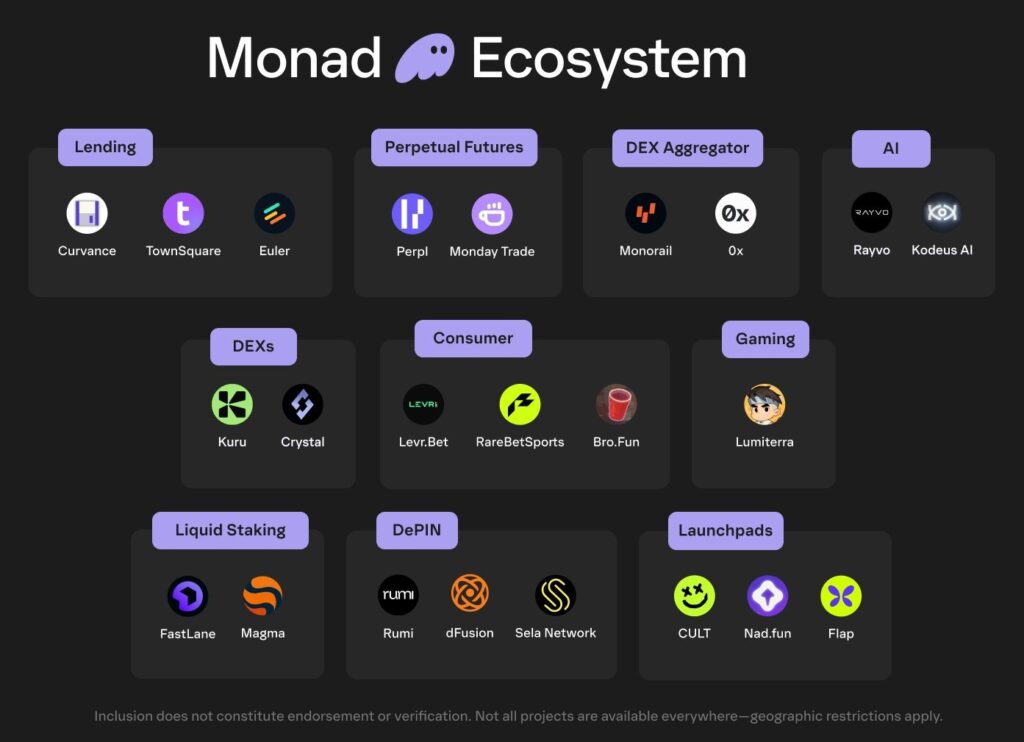
Leading Monad dApps Organized by Category (Data from Phantom.com)
Why Monad Is Interesting (Even If It’s Early)
Monad fits into a larger trend in blockchain development. Instead of throwing away Ethereum’s standards, newer networks are experimenting with better execution while keeping compatibility. That approach lowers friction and avoids splitting developers across completely different ecosystems.
It is still too early to know how Monad will perform under sustained load or whether it will attract long-term adoption. But from a design perspective, it’s a useful example of where Layer 1 development is heading.
Final Thoughts
Monad isn’t just another project claiming it’s faster than everything else. It’s an attempt to improve how transactions are handled without abandoning the tools and standards people already rely on.
Whether that balance holds up over time is something the ecosystem will decide. For now, Monad is worth understanding, especially if performance and developer experience are things you care about.