

Over the past few weeks, MegaETH has emerged as one of the most closely watched experiments in Ethereum’s Layer-2 landscape. While many scaling projects talk about cheaper fees or higher throughput, MegaETH is aiming at something slightly different. It is building infrastructure that can support real-time behavior on Ethereum-compatible networks.
Looking at how MegaETH is approaching its live stress test and system design, it becomes clear that the project isn’t chasing small efficiency gains. The emphasis is on whether a network can feel fast in practice while still remaining verifiable and broadly accessible, even as usage increases.
Latency, Not Just Throughput, Is the Core Target
Most Layer-2 networks today accept execution delays as an unavoidable trade-off. Transactions may be cheap and plentiful, but confirmation still happens on human-noticeable timescales. MegaETH takes a different position by treating latency, not raw throughput, as the primary bottleneck.
Internal performance targets operate in milliseconds rather than seconds, a threshold that materially changes what is feasible on-chain. Real-time trading, interactive gaming, social applications, and consumer payment flows all depend far more on responsiveness than on maximum transactions per second.
The emphasis on speed isn’t isolated from the rest of MegaETH’s design. Execution and verification are handled very differently, by choice. Intensive computation is pushed to the parts of the network built to handle it, while verification remains intentionally lightweight. In practice, this is what allows the system to feel responsive without turning participation into a hardware arms race.
A Live Global Stress Test, Not a Controlled Launch
MegaETH’s commitment to real-world performance is now being tested in public. The network has initiated a global mainnet stress test, inviting users to interact with live applications while deliberately pushing the chain under sustained load.
According to the project, the test targets 18,000–35,000 real transactions per second, alongside ultra-low fees and near-instant execution. Rather than relying on simulated benchmarks, MegaETH is exposing its infrastructure to genuine usage patterns from the outset.
The stress test setup itself gives a sense of what the team is trying to observe. There are live dashboards showing how MegaETH performs alongside other high-throughput networks, a public faucet to make participation easier, and a native bridge that settles slowly by design. Early applications are also accessible directly, rather than hidden behind gated tooling.
Seen together, these elements point to a stress test that is about more than peak numbers. The goal appears to be watching how the network behaves when people are actually using it, moving assets around, interacting with applications, and generating load at the same time.
In an industry where scalability claims are often deferred or abstract, MegaETH’s willingness to surface live data reflects a high degree of confidence in its underlying design and a preference for measurable results over controlled optics.
Performance Through Specialization and Trade-Offs
MegaETH’s performance doesn’t come from stripping the system down to its simplest form. If anything, it comes from accepting that not every part of the network needs to behave the same way.
Execution is handled by sequencers running on powerful, data-center-grade machines. That choice enables parallel processing and sustained throughput, but it also means the heavy lifting is deliberately concentrated in one place. Validation is handled very differently. With stateless validation, validators are not expected to keep a full copy of the blockchain or reprocess everything that came before. They only check what’s necessary for a given block, using compact cryptographic witnesses supplied alongside it.
The practical effect is that verification no longer demands specialized hardware. Validators can still enforce the rules of the network using ordinary consumer machines, even as execution scales aggressively. The cost of this approach is complexity. MegaETH doesn’t hide that trade-off, instead it builds around it.
Rather than treating specialization as a compromise, the network treats it as a prerequisite for achieving real-time performance at all.
Dual-Client Validation as a Security Backstop
Specialization inevitably raises questions about trust, and MegaETH addresses those concerns directly. From the outset, the network relies on more than a single validation path.
Alongside its own stateless validators, MegaETH uses an independent verification system developed with Pi Squared. Both systems receive the same data from the sequencer and independently compute the resulting state. A block only moves forward if their conclusions match exactly.
This setup doesn’t eliminate risk, but it narrows it. Bugs, edge cases, or unintended behavior would need to appear in two separate implementations at the same time. That kind of redundancy is rare among early-stage networks, particularly those pushing performance boundaries.
Instead of leaning on incentives alone, MegaETH places part of its security model in the software itself. That choice reflects a more cautious engineering philosophy, one that assumes failure is possible and designs accordingly.
Native dApps That Reveal What MegaETH Enables
Beyond infrastructure and metrics, the clearest signal of MegaETH’s direction lies in the kinds of applications emerging on the network. Several early dApps deployed during the live stress test are notable not because they are well-known brands, but because their functionality is tightly coupled to MegaETH’s real-time execution model.
A few early applications help illustrate what this design enables in practice.
Mania is built around real-time trading, where state updates happen continuously and execution speed matters more than batching efficiency. That kind of workflow is difficult to sustain on networks with multi-second confirmation times.
WarpX approaches the problem from a DeFi angle. It is built with the assumption that execution happens quickly and consistently, which lets it focus on swap speed instead of worrying about how well it translates to slower networks.
Crossy Fluffle sits more on the consumer side. The game depends on quick feedback and frequent on-chain updates, which is why it stays responsive without having to push most of the logic off-chain.
Smasher.fun takes a similar idea and stretches it further. It plays with interaction patterns that only start to work once execution stops feeling delayed and starts feeling continuous. These are experiments that become viable only when latency stops being the dominant constraint.
Beyond games and trading, Mega Warren shows how the same performance assumptions can apply to non-financial use cases. Built as a decentralized content system, it takes advantage of fast execution without requiring validators to run heavyweight infrastructure.
What unites these projects is architectural fit. They are not simply ports from other ecosystems, but applications shaped by the assumption that latency is no longer the dominant constraint. In that sense, they serve as early indicators of what developers attempt when real-time execution becomes practical.
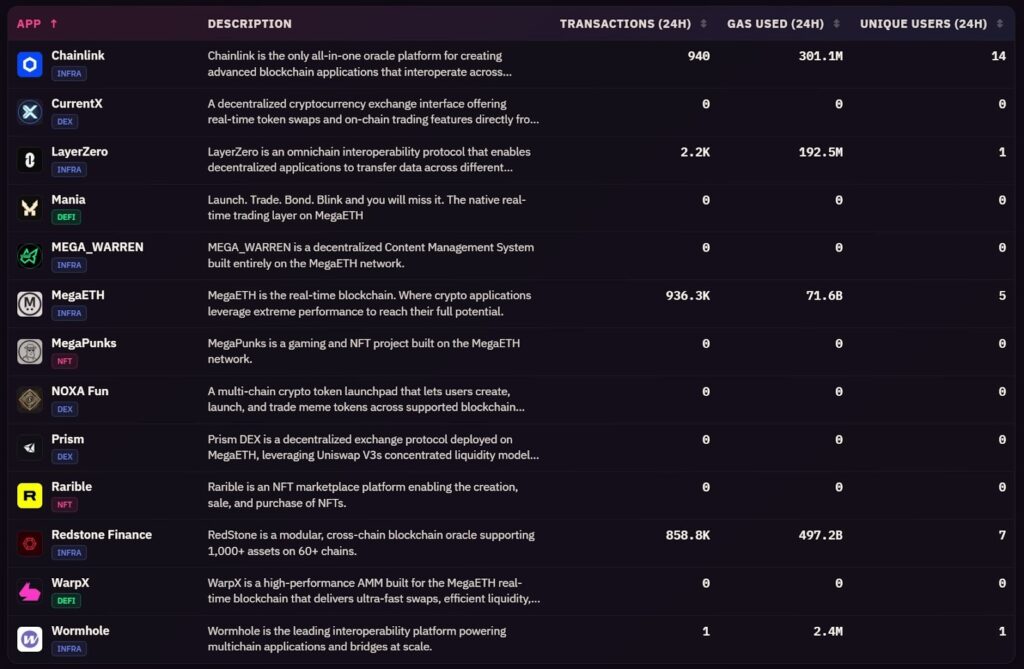
Live dApp activity on MegaETH during the mainnet stress test (source: miniblocks.io)
Token Supply and Public Sale Overview
MegaETH uses a fixed supply of 10 billion MEGA tokens. The intent is not aggressive short-term distribution, but a structure that supports incentives and ecosystem growth over time.
Only a small portion of that supply was made available at launch. Five percent, or 500 million MEGA, was allocated to a public sale on Ethereum mainnet. Instead of setting a single price, the team chose an English auction with a capped range, allowing demand to influence the final clearing price while keeping valuations within predefined limits.
Participation in the sale was kept broad. Prices started at $0.0001 per token, with an upper bound of $0.0999, and access was open globally. Due to regulatory constraints, U.S. accredited investors were subject to a one-year lock-up, which came with a pricing discount. Participants outside the U.S. were not bound by the same restriction.
The remainder of the token supply is allocated for the team, advisors, ecosystem initiatives, and investor rounds. These allocations are meant to fund ongoing development and infrastructure, with a stress on long-term adoption.
What MegaETH Is Ultimately Testing
Viewed as a whole, MegaETH represents a shift in how Layer-2 networks may evolve. Instead of treating decentralization, performance, and security as mutually exclusive, it reframes the problem around role separation.
Execution can be demanding. Verification does not have to be.
Whether MegaETH succeeds will come down to fairly basic things: how well the system holds up under real usage, how consistent performance remains over time, and whether developers actually choose to build on it. What matters more, though, is what the experiment is trying to prove. If execution can be pushed this far without making verification expensive or exclusive, then speed does not automatically undermine trust. At that point, real-time on-chain applications stop feeling theoretical and start looking usable.