

- What crypto miners are and how they work?.
- Prerequisites to run a crypto miner .
- Pros and cons of running a crypto miner.
A “crypto miner” is a person or a company that uses specialized computer hardware to solve complex mathematical problems. This process, known as “mining,” is a fundamental part of cryptocurrencies, like Bitcoin.
Many people think of crypto mining only as a way to generate new coins. In reality, mining serves a much bigger purpose: it verifies cryptocurrency transactions, records them on the blockchain’s distributed ledger, and safeguards the network against double-spending the risk of using the same digital currency more than once.
Crypto mining works a lot like mining for gold or other precious metals. Instead of digging through rock, miners use powerful machines to release new coins into circulation. To earn these rewards, their hardware must solve complex mathematical problems known as cryptographic hashes. A hash is essentially a shortened digital fingerprint of data, generated to keep information secure on a public network.
Miners compete to find the correct hash value for a block of transactions. The first to solve it earns the right to add that block to the blockchain and claim the reward. Each block is linked to the one before it through its hash, creating an unbroken chain that stretches all the way back to the very first block. This structure makes it easy for anyone on the network to verify whether a block is valid and whether the miner solved the cryptographic puzzle fairly.
As more advanced mining machines are introduced, the network automatically increases the difficulty of these puzzles. This arms race raises competition among miners and, at the same time, reinforces the scarcity of cryptocurrency, making each coin harder to obtain over time.
How Do Crypto Mining Hardware Work?
Crypto mining hardware works by performing complex mathematical calculations to validate transactions on a blockchain network and earn rewards in the form of cryptocurrency.
People mine cryptocurrencies with hardwares like ASIC miners, GPUs’ & CPUs’. The first two are the most common hardware options.
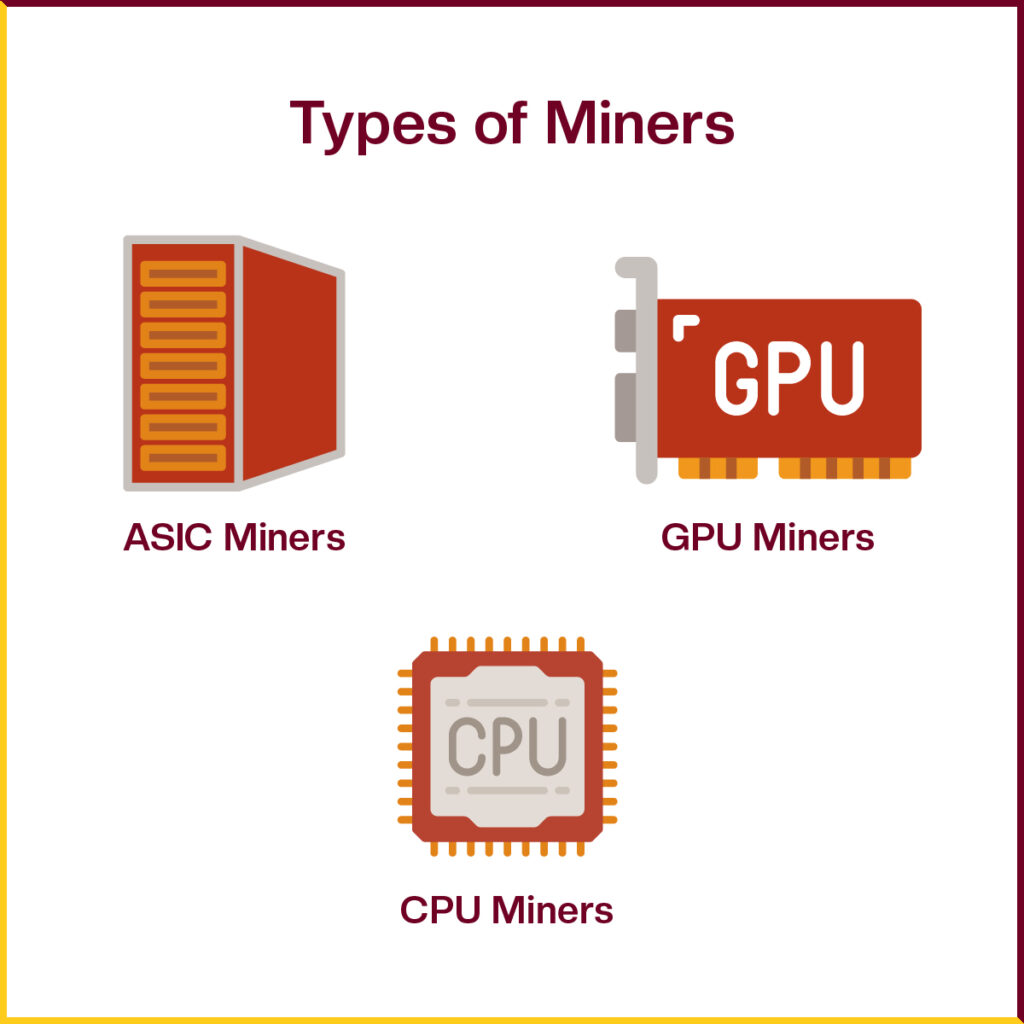
ASICs are specialized, purpose-built hardware designed to mine a single cryptocurrency or a group of cryptocurrencies that use the same algorithm. For example, a Bitcoin ASIC miner can only mine Bitcoin (or other coins using the SHA-256 algorithm).
So besides ASIC miners, GPU is another option that is used widely. However they are not as efficient as an ASIC miner. This process involves using the GPU’s powerful parallel processing capabilities to solve complex mathematical problems, which in turn verifies and adds transactions to a blockchain network.
Besides ASIC miners and GPU miners, CPU is another way of mining cryptocurrencies. However, not many people use a CPU anymore.
What Are The Prerequisites to Run a Crypto Miner?
Whether you are mining Bitcoin, Ethereum Classic, Monero, or other digital assets, mining requires far more than simply downloading a program and pressing “start.”
Successful mining depends on having the right hardware, software, environment, and knowledge in place. Below, we explore the key prerequisites you need before running a crypto miner.

1. Hardware Requirements
The most important aspect of mining is the hardware you use. Different cryptocurrencies require different types of machines:
- ASIC Miners (Application-Specific Integrated Circuits): Highly efficient, purpose-built devices for mining specific algorithms like Bitcoin’s SHA-256. They offer the best performance but cannot be repurposed for other tasks.
- GPU Rigs (Graphics Processing Units): Versatile and commonly used for mining coins such as Ethereum Classic, Ravencoin, and Ergo. They are less efficient than ASICs but more flexible.
- CPUs (Central Processing Units): Rarely profitable, but still useful for coins like Monero that are designed to resist ASIC dominance.
Along with the main mining hardware, you’ll also need:
- A motherboard and CPU (for GPU rigs).
- At least 8 GB of RAM for stable operation.
- A high-capacity Power Supply Unit (PSU) to handle constant loads.
- Proper cooling and ventilation systems to manage heat output.
- A stable, low-latency internet connection, ideally wired.
- (Optional but recommended) a UPS backup to protect against sudden power cuts.
2. Software Requirements
Mining is impossible without the right software setup:
- Operating System: Windows and Linux are common, while specialized OS options like HiveOS and RaveOS cater specifically to miners.
- Mining Software: Programs like CGMiner, PhoenixMiner, T-Rex, or NiceHash are necessary to connect your hardware to the blockchain or mining pool.
- Wallet Address: A secure wallet (hardware, software, or exchange wallet) is required to receive mining rewards.
- Mining Pool Membership: Solo mining is rarely profitable due to high network difficulty. Pools like F2Pool, Antpool, or Ethermine allow miners to combine resources and share rewards.
3. Environmental and Infrastructure Needs
Mining is not only about machines it’s also about where and how you run them.
- Electricity Supply: Mining consumes a lot of power. Profitability depends heavily on electricity costs in your area.
- Cooling Systems: ASICs and GPUs generate significant heat; without adequate airflow, hardware can degrade or fail.
- Noise Control: ASICs can be as loud as industrial equipment, making a dedicated space essential.
- Legal Compliance: Some regions restrict or ban mining due to energy concerns. Always check local regulations before setting up.
- Space: A well-ventilated, secure area is needed to house your rigs.
Running a crypto miner is not a plug-and-play task. It requires specialized hardware, proper software configuration, reliable infrastructure, and ongoing management.
The biggest deciding factor in profitability is electricity cost, but factors like cooling, legality, and hardware investment also play a major role.
What Are The Pros & Cons of Crypto Mining?
Pros
- Potential Profitability: Successful miners can earn significant rewards, especially during bullish market cycles when cryptocurrency prices are high.
- Network Contribution: Miners secure blockchain networks, supporting decentralization and trustless systems.
- Passive Income: Once set up, mining can generate income with minimal ongoing intervention, provided costs are managed.
- Technological Innovation: Mining has driven advancements in hardware (e.g., ASICs) and energy-efficient computing.
Cons
- High Energy Consumption: Mining, especially for Bitcoin, requires substantial electricity, raising environmental concerns and operational costs.
- Expensive Hardware: High-end ASICs and GPUs are costly, with top-tier models like the Bitmain Antminer S19 Pro costing $2,000–$10,000.
- Market Volatility: Cryptocurrency price fluctuations can render mining unprofitable if rewards don’t cover costs.
- Regulatory Risks: Some regions impose restrictions or bans on mining due to energy concerns or legal ambiguities.
- Technical Complexity: Setting up and maintaining mining operations requires technical expertise, particularly for optimizing hardware and cooling systems.
- Centralization Concerns: Large-scale mining pools and farms dominate some networks, potentially undermining decentralization.
Wrapping Up
Cryptocurrency mining is a complex and multifaceted process that serves as the backbone of many blockchain networks. Successfully running a crypto miner requires significant preparation, including a substantial investment in hardware, software configuration, and a suitable environment. The process relies on specialized hardware like ASICs and GPUs to solve cryptographic puzzles, with miners competing to be the first to validate a block and claim the reward.
Ultimately, crypto mining is a high-stakes endeavor that blends technology, economics, and infrastructure, playing a vital role in the ongoing evolution of the digital currency ecosystem.