

The Trump-Iran deadline has injected fresh volatility into global markets, pushing cryptocurrency values upward even as tensions simmer in the Middle East.
Over the weekend, President Donald Trump delivered a barrage of conflicting messages about Iran and the critical Strait of Hormuz, sparking a 2.5 percent bounce in overall crypto markets while whispers of a possible ceasefire began to circulate among traders and analysts alike.
The Trump-Iran deadline drama
The drama unfolded against the backdrop of a conflict that has dragged on for more than a month, disrupting one of the world’s most vital oil shipping routes and sending energy prices skyrocketing.
On Sunday, Trump took to his Truth Social platform with a raw, expletive-filled outburst that captured headlines everywhere. He warned that if the Strait of Hormuz remained closed, Iran would be “living in Hell,” vowing dramatic consequences if his demands went unmet.
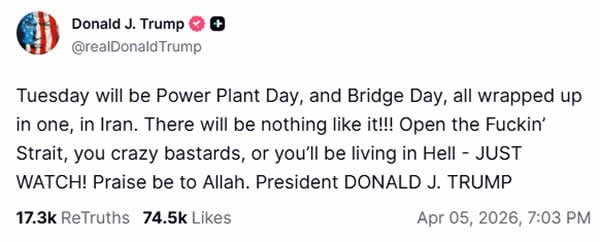
The post carried the weight of an ultimatum, with many interpreting it as tightening the screws on Tehran just as negotiations appeared to be gaining some traction. Meanwhile, the Iranian Embassy tweeted, “We’ve lost the keys.”
Yet, in a more measured tone during a Fox News interview, the president struck a different chord. He noted that Iran was “negotiating now” and voiced genuine optimism about striking a deal, suggesting there was a “good chance” something could materialize within the next 24 hours.
This blend of fire and optimism is classic Trump
As a direct consequence of the deadline imposed by Trump-Iran news, the total crypto market cap rose nearly $70 billion, or 2.5 percent, taking the whole crypto market sector to a level of almost $2.44 trillion for 11 days in Monday’s trade sessions.
The Bitcoin price has increased to $69,500 at the exchange of Coinbase, as reported by TradingView. This shows that whenever there is some kind of uncertainty related to geopolitics, people invest in cryptocurrencies, which can act as a hedge against traditional finance-related uncertainty.
A small uptrend caused liquidations of around $255 million, with 73 percent of them being shorts, as reported by CoinGlass. It seems many bearish bets got caught off guard by the sudden uptick in risk appetite fueled by hopes that the standoff might not escalate further.
The Trump-Iran deadline itself has evolved in recent days.
Initially, the administration floated a 10-day window for Iran to reopen the waterway. But Trump’s latest messaging appears to compress that timeline, pointing toward Tuesday as a pivotal moment.
Failure to comply, he suggested, could mean U.S. strikes targeting Iranian power plants and bridges. The colorful language in his Truth Social update left little room for misinterpretation: “There will be nothing like it!!!
Despite the aggressive posturing central to this Trump-Iran deadline saga, signs of de-escalation are emerging. Trump himself acknowledged ongoing talks, and reports indicate that U.S. officials along with regional mediators and Iranian representatives are quietly discussing the framework for a potential 45-day ceasefire.
If successful, such an agreement could not only reopen the strait but also pave the way toward a more permanent resolution to the conflict that erupted in late February. A source familiar with the discussions described the talks as serious, though still fragile, with both sides weighing the enormous economic and human costs of continued fighting.
The economic ripple effects of the Trump-Iran deadline and the underlying crisis are impossible to ignore. Crude oil prices have rebounded sharply, hovering around $112 per barrel on Monday morning as traders priced in the risk of prolonged disruption.
Analysts at The Kobeissi Letter warned that sustaining these levels for another seven weeks could push U.S. Consumer Price Index-related inflation toward 3.7 percent. American households are already feeling the pinch, shelling out an extra $240 million per day on fuel since the war began on February 28.
Rising energy prices pose the risk of contributing to inflation concerns, thus making it hard for the Fed to conduct its monetary policies due to the risks of an economic downturn.
What does the Trump-Iran deadline mean for crypto people?
For cryptocurrency enthusiasts, the Trump-Iran deadline chaos has proven to be something of a tailwind in the short term. The value of Bitcoin, alongside other alt-coins, has been known to rise when conventional safe havens such as bonds fall apart or when there is the need for an alternative in light of geopolitical news.
The most recent behavior in the markets indicates that traders are anticipating either a quick diplomatic solution or at least enough uncertainty to ensure that funds continue pouring into decentralized currencies.
However, experienced analysts warn that further developments could see a broader shift away from risks, which may ultimately impact cryptocurrency values as well.
Right now, all eyes remain fixed on Tuesday’s implied cutoff and the parallel diplomatic channels. But now that the Trump-Iran deadline is here, will the threat work in their favor, or will diplomacy come to the fore; remains to be seen.
A ceasefire agreement would calm the situation and help settle the uncertainty, which may allow global markets to normalize soon. On the other hand, the slightest mistake can escalate the conflict further, resulting in unforeseen implications for energy markets as well.
For the time being, the confusing signals being issued by Washington are creating plenty of opportunities for market volatility. It seems like cryptocurrency investors are optimistic about the de-escalation process but are also making provisions for an eventual escalation scenario.
The fast approaching Trump-Iran deadline means that the next few hours may make all the difference, not only for the Strait of Hormuz but for equities, commodities, and cryptocurrencies, too. In other words, the Trump-Iran deadline has provided new impetus for the crypto market, even though markets do not tolerate uncertainty.