


Prediction market data is pointing to a June 30 end to US military operations against Iran, and crypto traders are watching that deadline as closely as any on-chain signal.
On Polymarket, the world’s largest prediction market platform, the contract pricing a formal Trump announcement of war’s end by June 30 now trades at 85 cents, implying an 83% probability. Bitcoin is currently trading at $75,066, up 1.49% in the last 24 hours and 5.75% over the past seven days, with a market cap of $1.50 trillion. Ethereum sits at $2,358, up 1.73% on the day and 8.03% over the week.
Prediction markets tilt heavily toward a June resolution
The Polymarket market tracking Trump’s war-end announcement has drawn over $24.9 million in total trading volume since it launched in February 2023. The June 30 outcome is the leading contract, with the May 31 outcome sitting at 75%. Probability has shifted upward steadily; earlier in April, June 30 was priced at roughly 78%. The current 85% reading reflects growing trader confidence that a formal resolution is within reach before summer.
The backdrop is a fragile two-week ceasefire that Trump announced on April 7, brokered primarily by Pakistan with Egypt and Turkey involved as mediators. The ceasefire suspended US airstrikes and direct hostilities. According to reports, Iran has indicated that the terms are in broad agreement with its peace plan, which includes the lifting of sanctions and US withdrawal from regional bases. Trump stated that the United States already achieved military objectives.
Bitcoin and Ethereum have moved with every diplomatic headline
The crypto market has been a direct barometer of war sentiment since hostilities began. Bitcoin reached a record high of $126,198 in October 2025, then lost roughly 40% of its value as the conflict deepened. Since then, every diplomatic development has produced a price response. When Trump postponed planned strikes on Iranian energy infrastructure on March 23, BTC jumped more than 5% in a single session to $71,794. When the April 7 ceasefire was announced, Bitcoin crossed $75,000 for the first time since late March, and Ethereum moved above $2,200.
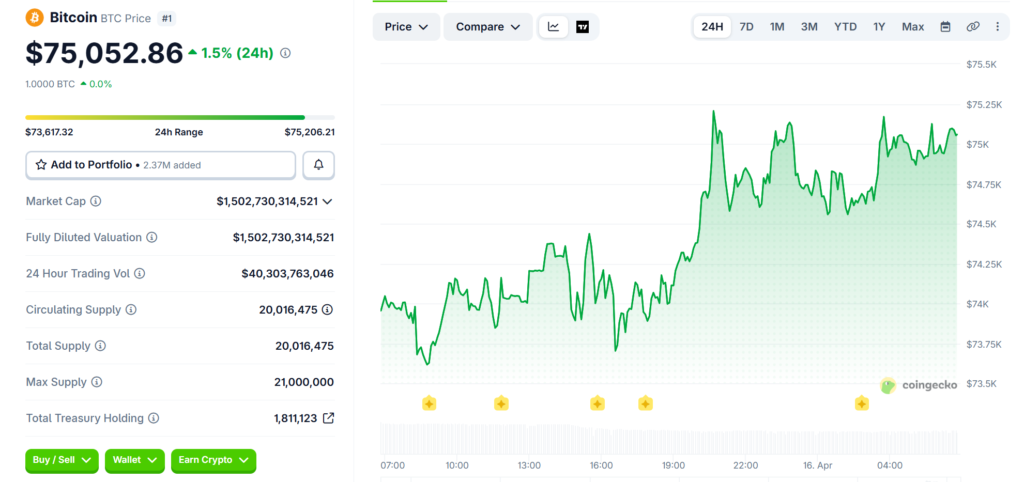
The opposite has been equally true. When US-Iran peace talks in Pakistan collapsed on April 11 and Trump announced a full naval blockade of the Strait of Hormuz, Bitcoin dropped from above $73,000 to around $70,600 within hours. ETH fell below $2,200 and XRP slid to $1.32. The broader CoinDesk 20 index fell nearly 2% in the immediate aftermath. Bitcoin has since recovered, supported by renewed optimism around a diplomatic resolution.
CFTC opens probe into oil futures trades ahead of Trump’s announcements
The war’s financial ripple effects have now drawn a formal regulatory investigation. According to a Bloomberg report published Wednesday, the US Commodity Futures Trading Commission is reviewing suspicious trading on CME Group’s NYMEX and the Intercontinental Exchange’s futures platforms. The probe focuses on two specific windows: March 23, when billions of dollars in oil futures traded roughly 15 minutes before Trump postponed Iran strikes, and April 7, shortly before the ceasefire announcement. In both cases, trading volumes spiked ahead of news that caused oil prices to fall.
The CFTC is requesting Tag 50 identity data from the exchanges as part of the investigation. Former CFTC enforcement director Brian Young stated that the agency has strong motivation to act. Brian stated that, After all, prices at the pump closely correlate to oil futures contracts, so American pocketbooks are what are at stake here.
Strait of Hormuz closure remains the decisive variable
Roughly a quarter of the world’s seaborne oil transits the Strait of Hormuz. Iran has restricted the waterway since the start of the war, and the US Navy blockade announced on April 12 added a second layer of restriction. With both sides now actively limiting traffic through the strait, oil prices remain elevated, the single biggest drag on crypto’s recovery potential.
Bitcoin has held a tight range between $65,000 and $73,000 throughout the conflict, even as equities experienced sharp volatility. Analysts say BTC’s next breakout depends almost entirely on how the war concludes. A formal end to hostilities and the reopening of the strait would reduce oil prices, ease inflation, and improve the case for looser monetary policy, conditions that have historically driven institutional flows back into crypto. With Polymarket now pricing June 30 at 83%, the market is not yet calling victory, but it is getting close.


