


The world of cryptocurrency never sleeps. Yesterday’s crypto update brought new ideas, regulatory issues, and changes in the market that show both the good and bad sides of this industry.
The crypto update from yesterday shows how the ecosystem is growing up as it deals with technical problems, lack of liquidity, and more government oversight. It talks about the work being done to link Ethereum’s growing layer-2 networks, keep track of on-chain commodity trading volumes, legal problems for prediction platforms, token sales when prices are low, and new rules about crypto donations.
Let’s take a closer look at what happened.
First Crypto Update: Ethereum Builders Suggest “Economic Zone” to Fix L2 Fragmentation
Ethereum is the main focus of one of the most forward-looking stories in yesterday’s crypto update. At EthCC in Cannes, developers from Gnosis and Zisk, with help from the Ethereum Foundation, showed off a new framework called the Ethereum Economic Zone (EEZ). This framework is meant to fix the problem of Ethereum’s many layer-2 rollups becoming more and more separate from each other.
As Ethereum has grown, dozens of L2 networks have made transactions faster and fees lower. But this success has a downside: liquidity, infrastructure, and user activity have all become spread out across different environments.
When users switch between chains, they often have to deal with clunky bridges, broken experiences, and repeated work. The proposed Ethereum Economic Zone wants to change that by allowing smart contracts on different rollups to work together with the mainnet and each other in real time, all in one transaction, without using traditional bridges.
The announcement said that the EEZ would allow seamless composability while still providing security guarantees that are as strong as those of direct mainnet deployment. Apps could use the same infrastructure across many rollups and still settle back to Ethereum’s base layer.
This method focuses on one of the main trade-offs in Ethereum’s scaling plan: getting a lot more transactions done at once versus keeping the ecosystem together.
If the framework is used, it could cut down on duplication, ease cross-chain friction, and make the overall experience better for both developers and regular users. It’s a big step that recognizes that there will be many rollups in the future, but it also tries to bring those pieces back together into a more unified economic zone. In the larger crypto update, this idea stands out as a helpful way to deal with the real problems of fast decentralization and scaling.
Onchain Commodity Trading Is Here to Stay, But Liquidity Remains an Issue
Onchain commodity trading is here to stay, but liquidity is still a problem.
Another important thing to note in this crypto update is that on-chain derivatives are still gaining traction, especially for traditional commodities and macro assets. On March 23, Hyperliquid’s HIP-3 market reached a new all-time high, with about $5.4 billion in perpetual futures volume across commodities and equity indices.
Silver had the most volume, with about $1.3 billion. WTI crude oil came in second with $1.2 billion, Brent crude oil came in third with $940 million, and gold came in fourth with $558 million. There was also a lot of action in equity indices like the Nasdaq and S&P 500. These numbers show that on-chain trading is no longer just a thing for crypto enthusiasts; it’s getting more and more people interested.
People who watch the industry say that this rise is proof that there is real demand for decentralized macro exposure around the clock. A chief investment officer said that on-chain commodity futures used to be mostly used by crypto fans, but that is changing.
Traders from traditional finance are now using personal accounts to trade, especially on weekends when regular exchanges are closed. Geopolitical events don’t take a weekend, and on-chain markets are rising to the challenge
Kalshi Legal Drama Worsens
Kalshi’s legal difficulties worsen with Washington State’s gambling lawsuit. Regulatory issues are a frequent topic in any crypto update, and Kalshi, a prediction market operator, is now under increased pressure. Last Friday, Washington State filed a lawsuit alleging that Kalshi’s event-based betting products violate Washington State’s gambling laws.
Last Friday, Washington State filed a lawsuit accusing Kalshi of violating gambling laws in Washington State with their event-based betting products.
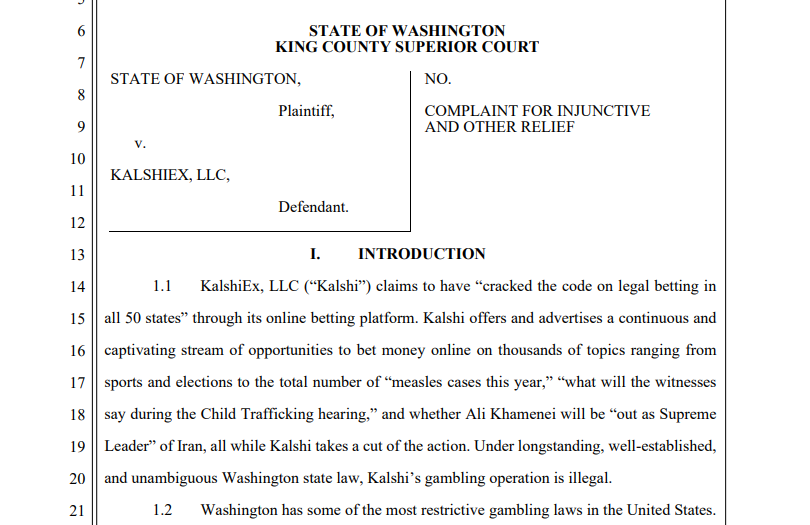
The Attorney General of Washington State argues that their interface, showing events, odds, and possible payouts, is very similar to traditional sportsbooks or gambling sites, despite being called a “prediction market” type of system.
The Washington Consumer Protection Act, Gambling Act, and other laws intended to recover money lost to illegal gaming activities have allegedly been violated.
Kalshi wants to move the case to federal court because similar cases are already being heard in other courts and the state didn’t give them any warning or talk to them first. This news adds to the ongoing discussions about how prediction markets fit into current systems for gambling and securities.
This crypto update shows how new ideas in decentralized or semi-decentralized betting are still running into problems with old state laws.
Sam Altman’s World Foundation Sells $65M in WLD as Token Hits New Lows
In the token markets section of this crypto update, Sam Altman’s World Foundation sold about $65 million worth of WLD tokens in an over-the-counter transaction.
In the past week, World Assets, the foundation’s token issuance arm, made deals with four other parties. The first tranche settled on March 20. The average price per token was about $0.27, and about 239 million WLD were traded.
The money will be used for core operations, research and development, making orbs, growing the ecosystem, and other things. $25 million of the total is locked up for six months, while the rest is available right away. After the news, WLD dropped to a new all-time low of about $0.24 before settling around $0.27. This is still a huge drop from its peak of about $11.82 last year.
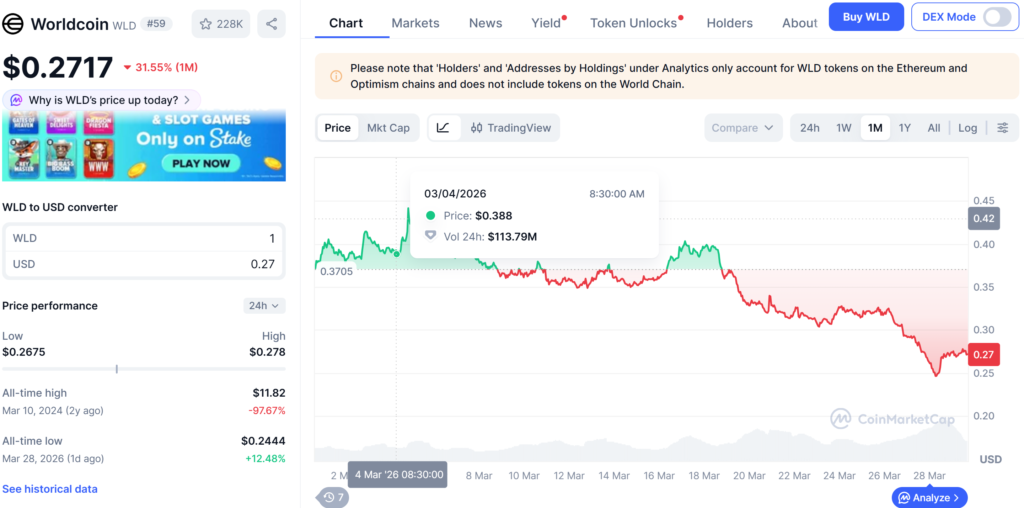
Perhaps there could be more supply pressure in case there is a major community token unlock scheduled on July 23. This could result in a significant portion of the total supply of 10 billion being released. Moreover, this round was also done at a significant discount in comparison to other funding rounds that were completed at much higher valuations.
This is an example of how difficult it is for projects to find funding at low prices. This is also part of an ongoing crypto update that includes aspects related to token unlocks and project sustainability.
Thailand Raids World-Linked Iris Scanning Site
The Thai authorities have taken action against iris scanning activities associated with the World project, making it even harder for the project to pass through the process.
Last October, the Thai authorities, including the Securities Exchange Commission and the Cyber Crime Investigation Bureau, raided an area where they suspected digital asset business activities without the necessary licenses. There were arrests, and investigations are still ongoing.
This is part of the trend of regulatory resistance that the project has encountered, especially in different places, including issues about the management of biometric data without a license. These are things that remind people that projects dealing with private information or new token incentives are subject to scrutiny. This is part of the warning in the current crypto update.
In Final Crypto Update, Canada Proposes Crypto Political Donation Ban Over Foreign Interference Fears
In the last crypto update, Canada suggests banning political donations in crypto because they are worried about foreign interference.
The proposed ban on all forms of cryptocurrency is part of the Canadian government’s proposed law, the Strong and Free Elections Act. The aim of the ban is to curb foreign interference in the elections by making it difficult to trace the money and by capping money orders and prepaid card donations.
The person who wrote the law said it is very important to keep the elections safe and free from external forces. Canada is not the only country taking such steps; the UK has also announced that it is banning the use of cryptocurrencies in the elections.
Since 2019, Canadians have been allowed to contribute to the elections in the form of cryptocurrencies, although it has not been very popular. A previous attempt to ban it in 2024 did not go very far.
If this law passes, people who break it could face fines and penalties that are twice the amount they contributed. The plan also makes it harder to use deepfakes to trick voters.
This change is another step in the ongoing relationship between crypto and traditional political systems, which is an important part of any full crypto update.
Yesterday’s events paint a picture of an industry pushing technical boundaries while grappling with liquidity gaps, regulatory friction, and the realities of token economics.
Stay stuck to Coin Medium as we bring you all the latest blockchain and crypto updates.


