



Taiwan is currently experiencing challenges resulting from geopolitical and economic risks. A recent review by a research fellow at the Bitcoin Policy Institute has proposed that Taiwan should seriously consider creating a Bitcoin reserve. This can offer the country critical protection against any potential conflict with China and currency weakening with one of its major trading partners.
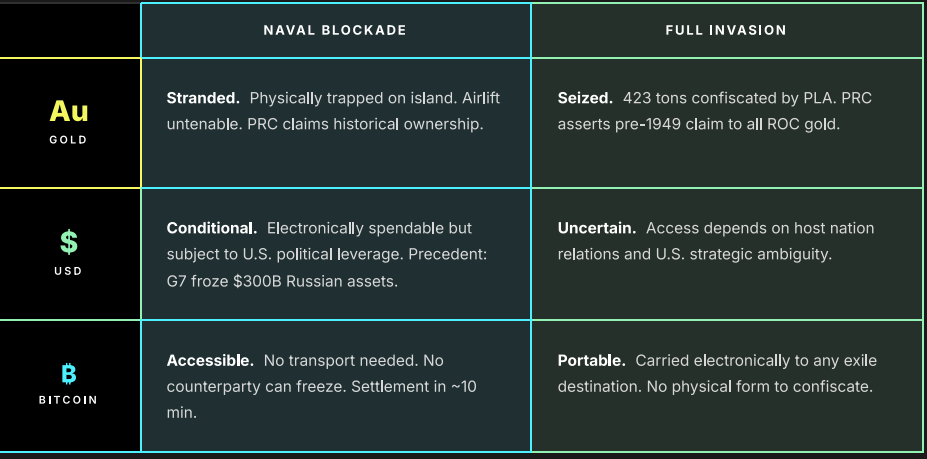
In his report released this week, Jacob Langenkamp highlights how a Bitcoin reserve stands out for its unique properties in times of crisis. Should China move toward reunification through military means, whether through a full invasion or a naval blockade, traditional assets could quickly become unusable. Gold bars and U.S. dollars can face restrictions in terms of access, while Bitcoin works on an open network with no physical movement needed.
This ability to bounce back makes a Bitcoin reserve particularly pertinent for Taiwan.
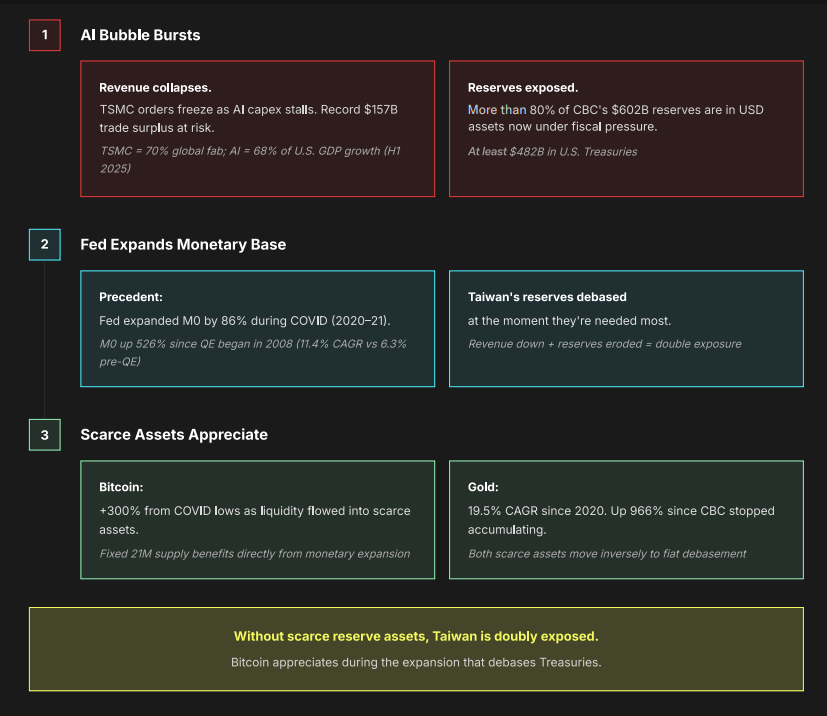
The island’s foreign exchange reserves are considerable, and a significant portion—exceeding 80 percent—is invested in assets linked to the U.S. dollar. Most of its international trade also runs through the dollar. While this setup has worked for decades, it leaves Taiwan exposed if American monetary policy shifts in ways that erode the currency’s value.
Langenkamp points to rising U.S. government debt, ongoing expansion by the Federal Reserve, and possible shocks from an AI sector slowdown or reduced demand for Taiwanese semiconductors as factors that could speed up dollar debasement.
He suggests pairing Bitcoin with existing gold holdings to create a stronger hedge. A modest allocation to a Bitcoin reserve would let Taiwan’s central bank, the CBC, get ahead of other nations and potentially deliver gains to its citizens as the asset appreciates over time.
Beyond hedging inflation risks, it could serve as geopolitical insurance against worst-case scenarios that leaders hope never materialize. It might also simplify certain cross-border trades by cutting out intermediaries and reducing friction in payments.
This idea has now caught the attention of various nation-states across the world. For instance, the United States and countries such as El Salvador have already built significant reserves. Similarly, Taiwan can benefit greatly by introducing even a small Bitcoin reserve as a way to become a first mover in Asia.
Last year, Taiwan’s central bank looked into the possibility of launching its own Bitcoin reserve. Lawmakers pushed for an evaluation, including a proposal to shift a portion of reserves, around 5 percent in one suggestion, into the digital asset. The CBC conducted a review but ultimately stepped back in December. Officials cited worries about price swings, questions around liquidity during large transactions, and challenges in secure custody.
Instead, they have reaffirmed the dollar as a safe and reliable option.
Langenkamp understands these issues as valid, especially considering the entity is in control of hundreds of billions in reserves. However, Langenkamp argues that these issues can be overcome.
As more entities and governments become aware of the lessons learned in the past, more options will be created in terms of professional custody. liquidity pools, and volatility management. With enough planning and advice from professionals, the CBC can overcome these problems while testing the waters with pilot programs.
Although the central bank has ruled out the possibility of a reserve based on Bitcoin at present, they have left the door open for additional exploration. They intend to test digital currencies in a controlled environment, commonly referred to as a sandbox, utilizing the Bitcoin currently held by the government.
Taiwanese politician Ko Ju-Chun made revelations last year regarding the government’s plans to test digital currencies. He explained that the Taiwanese Ministry of Justice currently holds about 210 Bitcoins. These coins have been seized over time through different criminal investigations. They were valued at about $14 million at the time of the revelation; however, their value is currently higher, at about $66,000 per BTC.
This existing stash gives Taiwan a practical starting point. If integrated thoughtfully into the sandbox testing, it could help officials better understand real-world operations without committing large new sums upfront.
Depending on how rankings are calculated, these 210 Bitcoin could place Taiwan among the top national holders globally, potentially seventh or eighth, sitting behind leaders like El Salvador but ahead of several European nations. Official trackers like BitBo have not always included Taiwan due to the holdings being under judicial rather than central bank control, but the potential is clear.
The larger picture!
Taiwan’s economy is built on technology and exports. Thus, it is vulnerable to global disruptions. The Bitcoin reserve will not replace the dollar or gold but will simply add another level of independence in case there are disruptions to traditional channels.
In a blockade situation, for example, the ability to move money instantly across the internet without needing banks or physical transport can be extremely valuable for emergency funds or for keeping operations alive.
Critics have focused on the volatility of Bitcoin, but proponents argue that due to the limited supply of 21 million coins, Bitcoin resembles commodities but is now digital. However, with the increasing use by both individuals and governments, volatility is reduced and the system becomes stronger.
For a place like Taiwan, constantly navigating complex international relations, building even modest resilience through, could pay dividends in stability and future optionality.
Langenkamp’s analysis also touches on trade benefits.
A Bitcoin reserve might open pathways for smoother settlements with partners less tied to traditional dollar systems, lowering costs and settlement times. In an era where supply chains face repeated stresses, from pandemics to regional conflicts, monetary tools that reduce dependence on any one power become increasingly attractive.
Of course, the central bank would be wise to be cautious in their role in managing public assets; however, the changing world would suggest that such a reserve would be worthy of periodic review. As nation-states are increasingly coming to recognize the importance of Bitcoin as part of their overall strategic position in the world, not considering this option at all may be the key factor in passing up an important potential solution.
Ultimately, the discussion about a Bitcoin reserve for Taiwan is not about speculation; it is about responsible planning. It is about managing potential economic threats related to the US dollar and, just as important, insuring against physical and economic isolation in the midst of conflict. While interest in this type of solution is growing around the world, Taiwan has the assets and the knowledge to explore this option with an open mind.


