

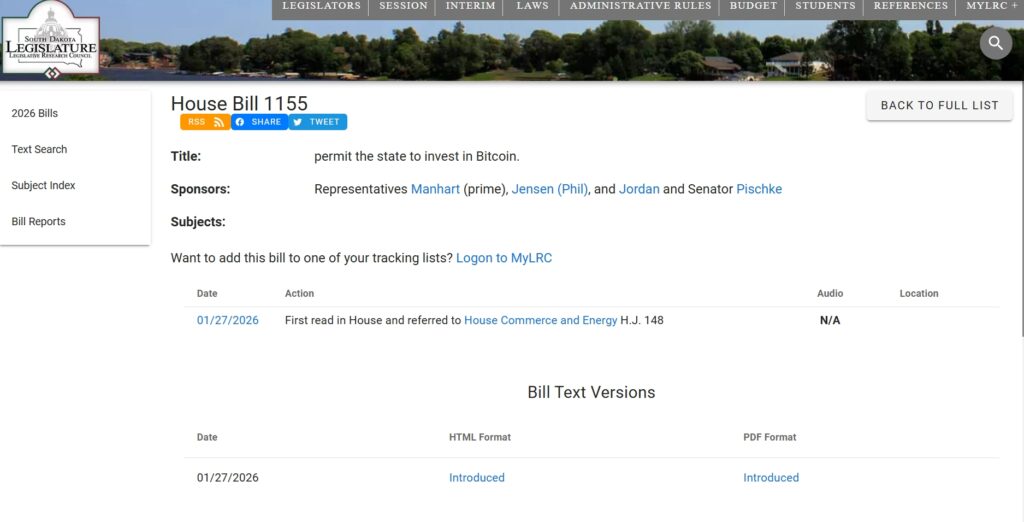
Republican Representative Logan Manhart just introduced House Bill 1155, breathing fresh life into the idea of a Bitcoin reserve for South Dakota.
The bill would tweak the state’s investment rules, greenlighting the State Investment Council to put as much as 10% of qualifying public funds into Bitcoin.
This BTC, whether through straight-up ownership, trusted custodians, or solid exchange-traded products, would go in for the planned Bitcoin reserve.
Manhart didn’t hold back on his excitement, posting on X to say, “I am proud to say I have released my bill that would allow the State of South Dakota to invest in Bitcoin.”
“Strong money. Strong state.”
He clearly is a staunch believer in Bitcoin being resilient, scarce, and a real hedge in uncertain times.
The proposal is not put forward haphazardly either. The bill clearly lays out regulatory guidelines, including tight custody rules for the Bitcoin reserve and routine security checks.
What will happen to this revived Bitcoin reserve bill now?
Right now, HB 1155 has cleared its first reading and landed with the Committee on Commerce and Energy for review. If it gains traction, South Dakota could join the handful of forward-thinking states already moving on a Bitcoin reserve strategy.
This isn’t Manhart’s first try. Last year’s House Bill 1202 laid out almost the exact same vision, adding Bitcoin to the list of approved state investments, but it got stalled when deferred past the session’s end.
Undeterred, he’s back with a refined version, riding a wave of momentum across the U.S. Kansas and Florida lawmakers are advancing their own ideas, while Arizona, Texas, and New Hampshire have already locked in legislation paving the way for state-level Bitcoin reserves.
Last year, President Donald Trump issued an executive order setting up a national strategic Bitcoin reserve with BTC seized through legal proceedings (and barred from being sold off).
South Dakota’s latest effort shows how quickly attitudes are shifting.
A Bitcoin reserve isn’t about chasing hype. It’s about positioning for strength, diversification, and future-proofing public finances. With Republican Manhart leading the charge, the question isn’t if more states will follow, but how fast.