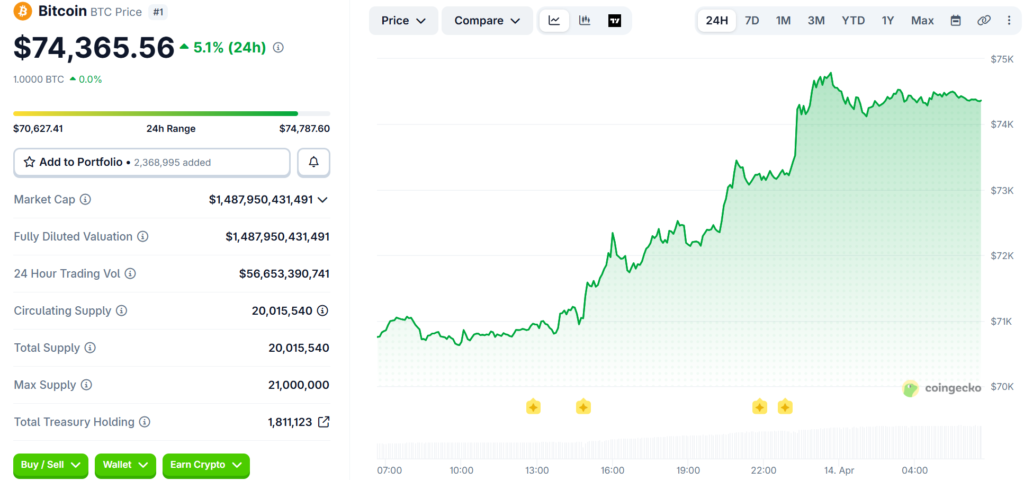




Bitcoin (BTC) climbed to a four-week high near $75,000 on Tuesday, April 14, fueled by renewed hopes of a US-Iran diplomatic deal and a cascading $530 million quick squeeze that liquidated over 177,000 traders in 24 hours.
How the short squeeze unfolded
Bitcoin moved from a morning low of $70,741 to intraday highs above $74,900 within hours. Analysts had flagged a large cluster of leveraged short positions stacked in the $72,000–$73,500 range, and once prices pierced that band, liquidations accelerated the move sharply upward. Of the $530 million in total liquidations, roughly $425 million, or 80%, were leveraged short positions on Bitcoin and Ether, according to CoinGlass data.
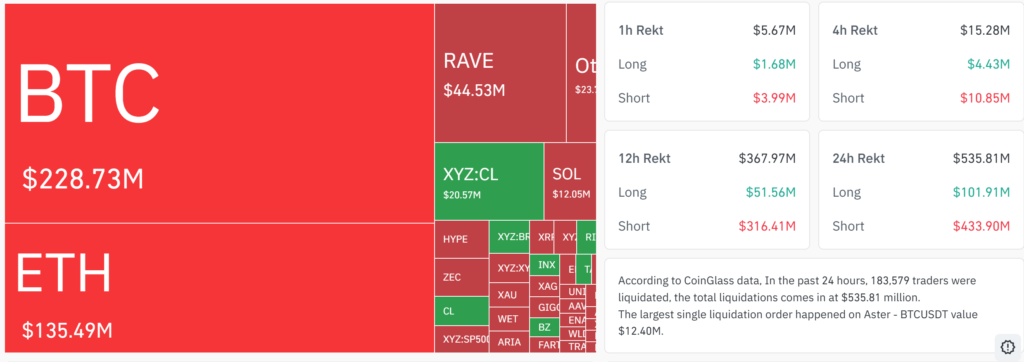
Funding rates had turned negative in the days before the rally, signaling that bearish positioning had grown unusually crowded heading into the weekend. The total crypto market cap surged to $2.6 trillion, its highest level in a month. On X (formerly Twitter), analyst Valerius Labs cautioned that “This isn’t a breakout. It’s a short squeeze running into overhead supply,” while Bull Theory noted that the squeeze added over $100 billion to total market capitalization within hours.
Iran deal hopes shift market sentiment
The macro catalyst behind the move was a sharp reversal in US-Iran sentiment. Over the weekend, Vice President JD Vance announced that peace negotiations in Islamabad had collapsed without an agreement. President Trump then ordered a naval blockade of the Strait of Hormuz, sending Bitcoin back toward $70,741 on Sunday. But markets reversed course on Tuesday after reports emerged that Iran was considering concessions on its nuclear program as a path to ending the conflict.
Jeff Mei, Chief Operating Officer at BTSE, stated that markets are rallying because traders believe the US and Iran are coming closer to a deal. He noted that Iran’s economic lifeline depends on oil exports, and a US blockade of the Strait of Hormuz could severely damage its economy. Oil prices had surged past $104 per barrel at the height of the tensions, reinforcing inflation concerns and complicating the Federal Reserve’s rate-cut timeline.
Strategy adds $1 billion in BTC on the same day
Adding institutional weight to the move, Strategy (formerly MicroStrategy) disclosed a purchase of 13,927 BTC for approximately $1 billion at an average price of $71,902 on April 13. The firm’s total holdings now stand at 780,897 BTC, acquired for a cumulative $59.02 billion at an average cost of $75,577 per coin.
The buy was funded through Strategy’s STRC preferred stock at-the-market program, which recorded over $1 billion in single-day trading volume, a new high for the instrument. Matthew Sigel, Head of Digital Assets Research at VanEck, flagged the STRC volume spike on X as a direct signal of the Bitcoin purchase.
What analysts are watching
Spot Bitcoin ETFs recorded $471 million in net inflows on April 6, the strongest single day since late February, with BlackRock’s IBIT, Fidelity’s FBTC, and Ark Invest’s ARKB absorbing the bulk. Morgan Stanley’s MSBT, launched April 8 as the first spot Bitcoin ETF from a major US bank, drew $34 million in day-one inflows.
Several trading desks now cite $75,000 as the critical resistance level. A sustained close above that zone, analysts say, could open a path toward $80,000. Downside risks remain, however. Tax-season selling ahead of the April 15 deadline may reduce spot demand in the near term, and Bitcoin continues to trade as a high-beta macro asset, meaning any fresh escalation in the Iran conflict could quickly reverse the current momentum.
At the time of writing, BTC is trading at approximately $74,363, up 5.08% in the past 24 hours, with a market cap of $1.49 trillion and 24-hour trading volume of $56.65 billion.