Covenant AI, the team behind the large-scale Covenant-72B model trained by over 70 distributed contributors, announced its departure from Bittensor on April 10, alleging that governance on the network is not truly decentralized in practice.
Covenant AI founder Sam Dare directed his accusations specifically at Bittensor founder Jacob Steeves, describing the network’s governance as “decentralization theatre.” In a detailed public statement, Dare listed a series of actions he attributed to Steeves: the suspension of emissions to Covenant’s subnets, the removal of moderation rights over their own community channels, the unilateral deprecation of their subnet infrastructure, and large token sales timed to moments of conflict, which he described as direct economic pressure applied against the team.
Covenant AI operated three high-emission subnets, SN3, SN81, and SN39, making it one of the network’s most significant builders. Dare confirmed he sold his entire subnet holdings, amounting to more than 37,000 TAO tokens. The team stated it would continue its research outside Bittensor and signalled upcoming announcements: “Our research, our team, our models, and our vision go with us.”
A whistleblower site enters the picture
The same day Covenant AI published its exit, a newly launched website called Tao Papers surfaced with what it describes as on-chain forensics and leaked internal documents obtained from multiple whistleblowers inside the Bittensor ecosystem.
The site claims to have reviewed signing logs covering 41 network upgrades between 2023 and 2026, finding that in 38 of those 41 cases, the proposing key, the first signer, and the deployment hash all trace back to infrastructure controlled by Steeves. Co-signers added their signatures within minutes and without any referenced public discussion. Tao Papers characterizes the multisig structure not as governance but as “a counter-signature ritual on decisions already made.”
The site also documented seven subnets whose emissions were throttled or cut to zero within 72 hours of their operators publicly criticizing Steeves on social channels. Technical justifications, it claims, were posted only after the fact. Of 11 recorded subnet deprecations, not one referenced a written policy, a community vote, or a notice period. In two cases, subnet owners reportedly learned their projects had been deprecated through screenshots sent by other community members.
TAO price and market reaction
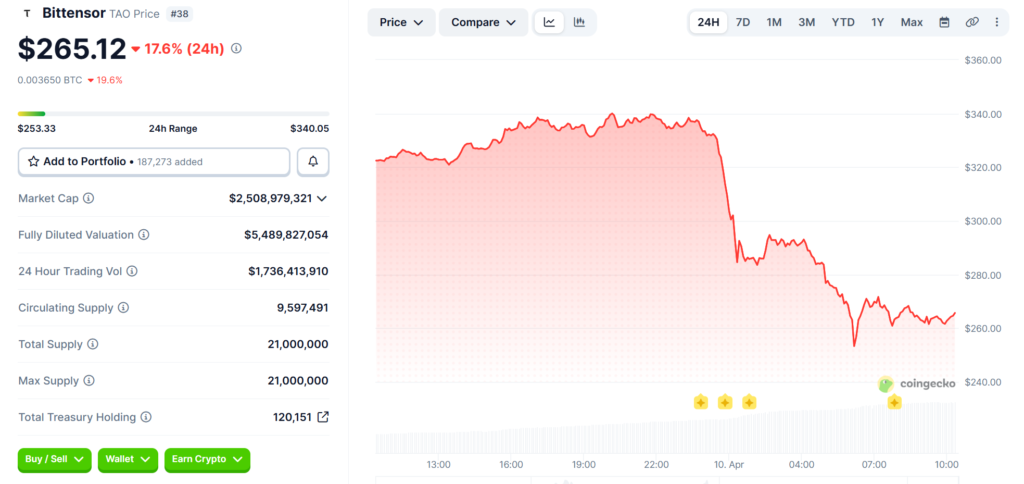
TAO dropped more than 15% immediately following the announcement, sliding from around $337 to $284 according to CoinGecko. By press time the token had extended its losses. CoinMarketCap data shows TAO trading at approximately $262.70, an 18.80% decline in 24 hours and a 14.65% drop over seven days. Market capitalisation stood at roughly $2.5 billion against a circulating supply of 9.6 million TAO, while 24-hour trading volume surged past $1.73 billion, rising approximately 156% as investors moved to exit positions.
Derivatives data from CoinGlass showed Bittensor futures open interest falling nearly 1% in a single hour, with sharp corrections across OKX, Gate, Bitget, Hyperliquid, and LBank. Analyst Cheds Trading flagged the risk of a deeper correction below the 200-day moving average, noting the token had previously rallied more than 100% and was now unwinding that move rapidly.
A 90% rally built on this team’s work
The timing makes the exit hit harder than a typical team dispute. TAO had rallied as much as 90% over a single month heading into April 2026, standing out in an otherwise weak broader market. That move was driven significantly by the Covenant-72B model, a 72-billion-parameter language model that Covenant AI trained across more than 70 independent contributors on commodity hardware, marking one of the largest decentralised LLM pre-training efforts ever completed.
The project had attracted high-profile endorsements. Nvidia CEO Jensen Huang publicly praised the Covenant-72B effort, and Silicon Valley investor Chamath Palihapitiya referenced it on his All-In podcast, adding the credibility that drew fresh institutional and retail capital into the ecosystem. Subnet tokens mechanically linked to TAO posted amplified returns of up to 400% during the same window. With Covenant AI gone, the market is repricing how much of that rally belonged to the team rather than the network.
The broader decentralization debate
The allegations are not landing in a vacuum. A pre-existing April 2026 investment analysis had already flagged governance concentration as a structural risk, noting that two subnet operators, Chutes and Rayon Labs, control roughly 40% of emissions, and that a 12-validator Senate arrangement sits in tension with Bittensor’s public decentralisation claims.
Earlier this year, Steeves stepped down as CEO of the Opentensor Foundation in a move framed at the time as a deliberate step toward decentralisation. He retained involvement in protocol development. Covenant AI’s exit letter now directly challenges whether that title change reflected any operational shift in how the network is actually controlled.
Steeves did not issue a detailed public rebuttal. His brief response suggested the departure would push Bittensor toward subnets that “run headless and as true commodities”, a statement some read as signalling a new phase, and others as sidestepping the core governance concerns raised by Dare.
What this means for decentralised AI networks
Bittensor has positioned itself as the benchmark infrastructure play for decentralised AI, drawing comparisons to Bitcoin for machine intelligence and attracting Grayscale to file for a regulated TAO trust with the SEC. The Covenant AI exit puts that positioning under direct stress.
If the network’s most celebrated builder, responsible for a milestone that drew Nvidia’s CEO to publicly endorse the project, walks away citing governance capture, the gap between Bittensor’s narrative and its operational reality becomes difficult to ignore. Competing decentralised AI networks including Fetch.ai, Render, and Akash are watching closely.
Covenant AI has not yet announced where it will continue development, but further announcements appear imminent. Whether Bittensor can demonstrate credible governance reform quickly enough to retain builder confidence, or whether this week marks the start of a longer re-rating, is now the central question for TAO holders.