


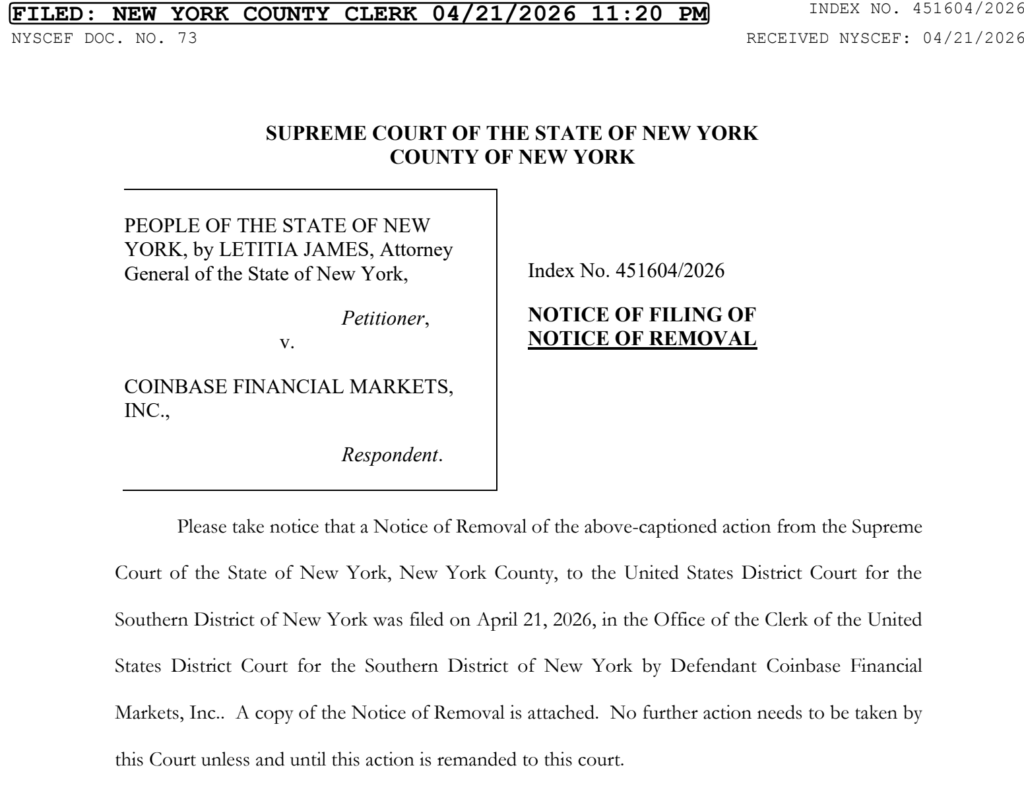
In a significant development in event-based trading, Coinbase has moved its legal dispute over New York prediction markets from state court into federal territory.
The company’s chief legal officer, Paul Grewal, announced the shift on Wednesday, highlighting that the case involves important questions of federal law regarding how these innovative platforms should be regulated.
This marks an escalation in the ongoing tension between state authorities and federal oversight when it comes to New York prediction markets.
By removing the lawsuit to federal court, Coinbase argues that New York’s claims raise “disputed and substantial questions of federal law” and are subject to complete preemption.
In other words, the company believes the core issues centered on event contracts belong under national rules rather than varying state gambling statutes.
What do we know about Coinbase’s New York prediction markets battle?
The lawsuit itself stems from a filing by New York Attorney General Letitia James on Tuesday against Coinbase Financial Markets and Gemini Titan. It alleges that their New York prediction market offerings allow users to place bets on everything from sports and entertainment outcomes to election results without the proper state gaming license.
The suit also points out that these platforms are accessible to users aged 18 to 20, below New York’s legal gambling age of 21 for certain activities. James is seeking fines, forfeiture of any alleged illegal profits, customer restitution, and an injunction to halt similar offerings unless the companies comply fully with state requirements.
This case deserves special attention because it can help establish the rules of regulation of prediction markets operating in New York.
If successful, the state’s position could strengthen the hand of local regulators in treating these tools as gambling. On the other side, Coinbase maintains that New York prediction markets qualify as federally regulated national exchanges under the oversight of the U.S. Commodity Futures Trading Commission (CFTC). Grewal emphasized that the company will keep pushing for the federal framework that Congress originally intended.
This isn’t happening in isolation.
Over recent months, state regulators in multiple places have increased scrutiny on prediction market platforms, with at least 11 states taking some form of legal action.
Coinbase launched its New York prediction markets services on January 28, making event contracts available across all 50 states, including New York, covering real-world outcomes in sports, politics, culture, and beyond. The firm positions these as legitimate financial tools rather than games of chance.
The broader conflict between state and federal authority has already played out in other arenas. For instance, the CFTC recently filed lawsuits against gaming regulators in Illinois, Connecticut, and Arizona, asserting its exclusive jurisdiction over properly registered event contracts and arguing that states cannot impose their gambling laws and licensing demands on CFTC-approved platforms.
Such similar petitions have been made concerning other companies, such as Kalshi and Polymarket, demonstrating an increasing debate nationwide.
Indeed, the fate of Coinbase’s prediction markets in New York may be significant for ordinary users as well as for the development of the prediction markets segment itself.
So far, Coinbase has been confident in its stand on the issue, and the discussion on New York prediction markets moves rapidly.