




Bitcoin erased a sharp late-week recovery on Sunday and into Monday after the US Navy fired on and boarded an Iranian cargo ship in the Gulf of Oman, fracturing the fragile two-week ceasefire between Washington and Tehran just days before it is due to expire. The price of bitcoin slipped below $75,000 but has stayed steady above $74,000.
A naval seizure breaks the calm
The USS Spruance, a guided missile destroyer operating under US Central Command, intercepted the Iranian-flagged cargo vessel Touska on Sunday as it sailed toward the Iranian port of Bandar Abbas at roughly 17 knots. According to CENTCOM, the Touska’s crew ignored repeated warnings from US forces over a six-hour period before the Spruance disabled the ship’s propulsion system by firing multiple rounds into its engine room. US Marines then boarded the vessel from the USS Tripoli, which carried the 31st Marine Expeditionary Unit to the region last month.
President Donald Trump announced the seizure on Truth Social, writing that the Navy “gave them fair warning to stop” and that the Iranian crew “refused to listen.” He added that the Touska was already under US Treasury sanctions for prior illegal activity. CENTCOM confirmed the seizure and said that since the naval blockade began, US forces have directed 25 commercial vessels to return to Iranian ports.
Tehran closes the Strait and cancels talks
Iran’s response was swift. After briefly reopening the Strait of Hormuz during the ceasefire period, Tehran reimposed full restrictions on the waterway, which carries approximately 20% of the world’s crude oil and natural gas. Iranian parliamentary speaker Mohammad Bagher Qalibaf stated on state television that passage through the strait would remain blocked for as long as the US maintained its port blockade, saying it was impossible for others to transit while Iran could not.
Tehran also pulled out of a second round of peace talks scheduled for Monday in Islamabad, Pakistan. Iran’s official news agency IRNA confirmed the withdrawal, with Iranian officials citing the ongoing blockade as a violation of the ceasefire terms. The US delegation, led by Vice President JD Vance, special envoy Steve Witkoff, and Jared Kushner, had been preparing to travel to Pakistan for the negotiations.
Iran’s military issued a separate warning that it would retaliate for the ship seizure. Adding a longer-term dimension to the standoff, the head of Iran’s parliamentary construction committee said a comprehensive Strait of Hormuz management law is nearing completion.
Bitcoin price and market data
At the time of writing, Bitcoin is trading at $74,783.40, down 1.29% over the past 24 hours, though still up 5.17% on the week. The 24-hour trading volume stands at $38.82 billion, and Bitcoin’s market cap sits at approximately $1.49 trillion on a circulating supply of around 20 million BTC.
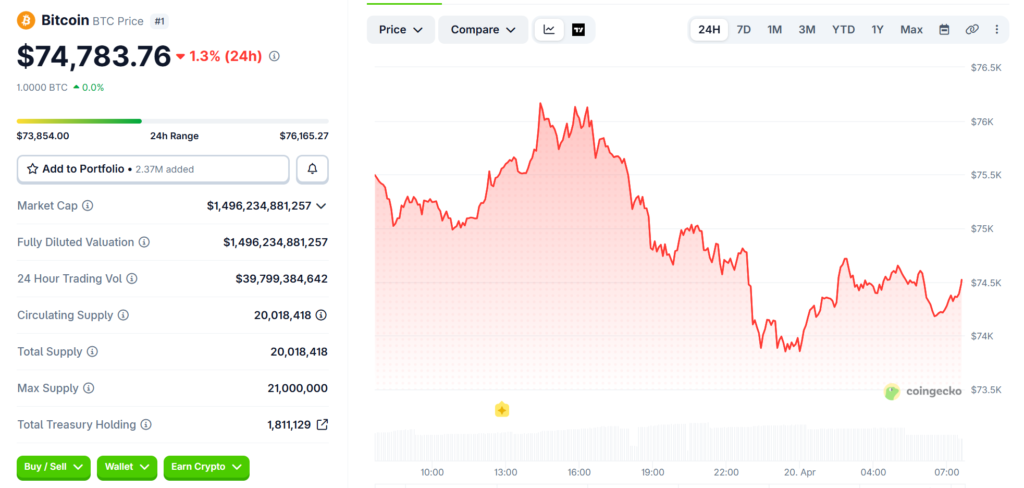
The weekend began with clear momentum. Bitcoin surged past $78,300 late on Friday on Coinbase, its highest level since early February, before Iran’s Saturday threat to close the Strait of Hormuz pulled it back into the $75,000 to $76,000 range. The Touska seizure on Sunday evening sent it briefly below $74,000, erasing the weekly gains that had briefly brought institutional sentiment back into positive territory.
Traditional markets moved sharply. US S&P 500 futures fell 0.8%, Nasdaq-100 futures dropped 0.6%, and Dow Jones futures declined roughly 0.9%, equivalent to about 450 points, on Sunday night. Oil futures climbed more than 4.5% to above $95 a barrel on the Strait closure threat. Brent crude rose 5.7% on the day, extending a trend that has kept inflation expectations elevated throughout the conflict.
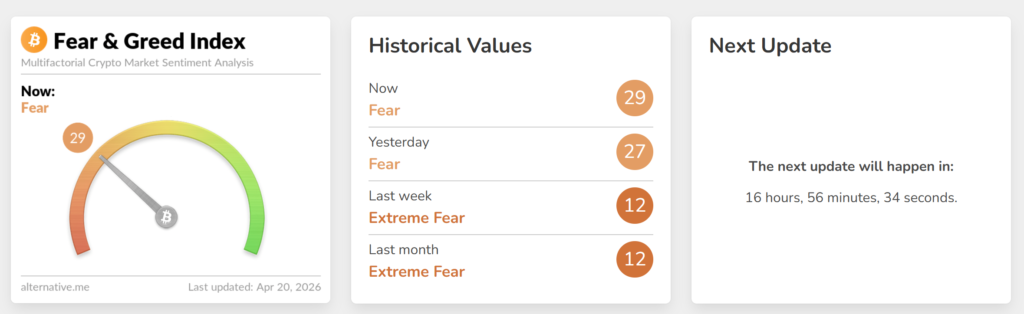
The Crypto Fear and Greed Index rose two points to 29 out of 100 on Monday, its highest reading since late January, though sentiment remains firmly in fear territory.
What the next 48 hours could determine
The ceasefire is set to expire on Wednesday, and the collapse of Monday’s talks leaves no immediate diplomatic framework to extend it. Key sticking points heading into any resumed negotiation include Iran’s stockpile of approximately 400 kilograms of 60% enriched uranium, a US demand to transfer it has been called a non-starter by Iranian officials, and the scope and timeline of sanctions relief, with Tehran seeking the unfreezing of more than $20 billion in assets.
Bitcoin’s ability to hold above $74,000 through the weekend, even as equities and oil repriced sharply, reflects a degree of resilience that was not visible in earlier escalation cycles. Whether that floor holds into Wednesday’s ceasefire deadline will depend as much on whether any diplomatic channel re-opens as on anything happening on a price chart.