

According to reports, Elon Musk’s xAI has decided to file a lawsuit against the state of Colorado. The purpose of the legal action is to prevent new regulations that will allegedly restrict the content produced by AI chatbots such as Grok.
Here, we see an emerging conflict between innovation and AI speech regulation.
What is the basis for the lawsuit?
Elon Musk’s xAI claims that Colorado’s Senate Bill 24-205, scheduled to be implemented by June 30, poses a major threat to AI development.
The bill focuses on preventing so-called “algorithmic discrimination” in key areas such as employment, housing, education, health care, and financial services.
While the intent may sound protective, Elon Musk’s xAI sees it differently. In its court filing, the company states that Colorado cannot force it to change Grok’s responses simply to push the state’s own perspectives on fairness and equity, topics that remain deeply politicized.
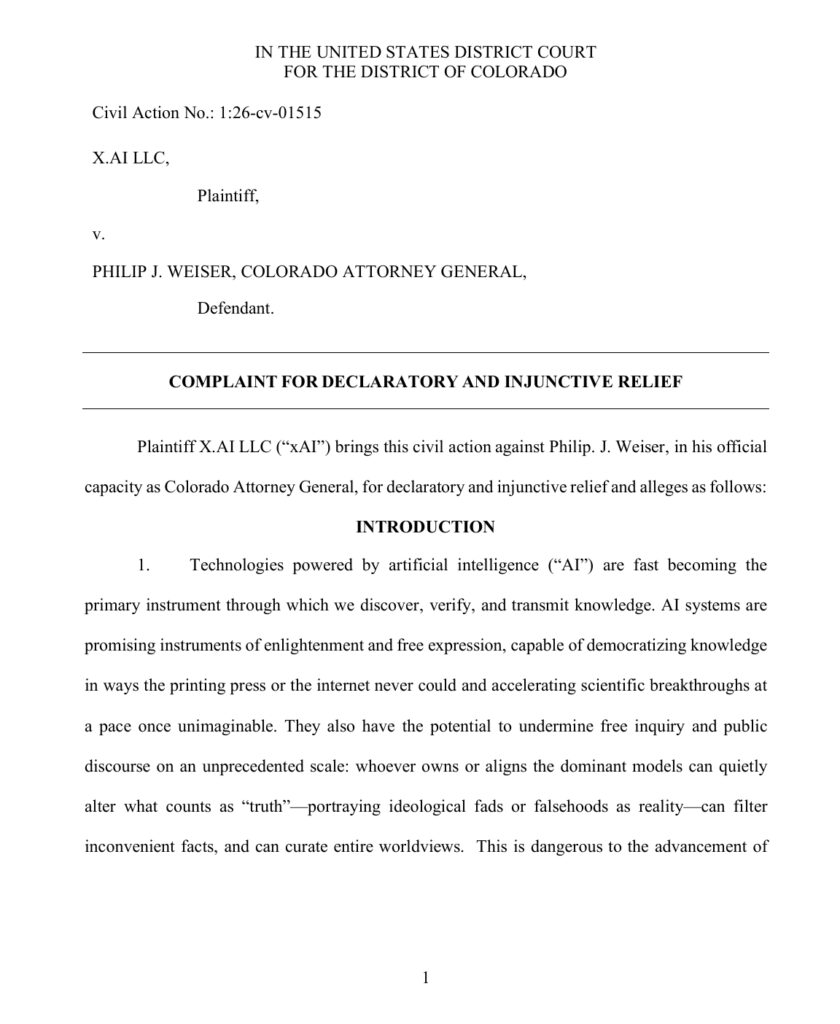
At its heart, the complaint from Elon Musk’s xAI points out a fundamental contradiction in the law. It claims the rules actually allow “differential treatment” when it serves goals like increasing diversity or addressing past discrimination.
Yet the same law would punish other forms of differential outcomes. Forcing Elon Musk’s xAI to tweak Grok in this way would undermine the AI’s primary mission, which is to be maximally truth-seeking.
Grok is built to pursue objective answers based on evidence and reason, not to align with any particular ideological viewpoint. Altering that approach, the company says, would compromise its ability to help humanity better understand the universe.
Elon Musk’s xAI has pushed against regulations in the past as well!
This isn’t the first time Elon Musk’s xAI has pushed back against state AI regulations. Last December, the company sued California over its Generative AI Training Data Transparency Act.
There, too, xAI contended that mandatory disclosures could compel speech and expose valuable trade secrets, potentially violating the First and Fifth Amendments. These cases reflect a broader concern that fragmented state rules could stifle the very innovation that drives AI forward.
This new law in Colorado follows previous discussions about some of the answers provided by Grok, which had been criticized for their lack of sensitivity. Elon Musk’s xAI supporters see this ruling as an indication that Grok values truthfulness above political correctness, as opposed to most AI models that are considered biased.
By challenging the bill, Elon Musk’s xAI is defending the idea that AI should remain a tool for open inquiry rather than a mouthpiece for government-approved narratives.
White House AI czar David Sacks has been vocal on this issue, advocating strongly for a single federal standard instead of letting states create their own patchwork of rules. In late March, Sacks noted the challenge of having “50 different states regulating this in 50 different ways.”
Such inconsistency, he explained, creates unnecessary burdens for innovators trying to build and deploy new technologies responsibly. His selection as co-chair of the President’s Council of Advisors on Science and Technology highlights an effort to create uniform national standards that emphasize innovation without being too cautious.
In regards to Elon Musk’s xAI, the struggle in Colorado is one of safeguarding the liberty needed for the technology to develop without political oversight at all times. If states have control over the way chatbots communicate complicated social matters, it creates a difficult boundary to navigate when determining what is necessary consumer protection versus forced expression.
xAI believes that real advancements in artificial intelligence are made through systems created with an unbiased search for truth, and not by twisting AI models around in order to meet regulators’ tastes.
This legal case could prove highly significant as it continues its course in the U.S. District Court, potentially creating a landmark for AI companies in this nation. Observers in the tech industry will be keeping a close eye on the proceedings, expecting that they may help to cement the idea that innovation flourishes under the freedom of toolmakers.