


The recent news from the world of cryptocurrencies combines both the developments in regulation, fresh claims about the inventorship of Bitcoin, amazing pricing moves related to geopolitical events, and breakthroughs in the adoption of cryptos by the world of conventional finance. Whatever your level of experience in the cryptocurrency market, here are the top stories of the last days in the industry.
Crypto update one from Washington
Another significant part of this crypto update comes from Washington, where the US Department of the Treasury continues to implement the GENIUS Act. This bill will be enacted in July 2025 and intends to establish an appropriate regulatory structure for payment stablecoins while at the same time ensuring that risks are mitigated. The two agencies of the Department, namely FinCEN and OFAC, have published in a notice this week a joint proposed rule intended to fight money laundering.
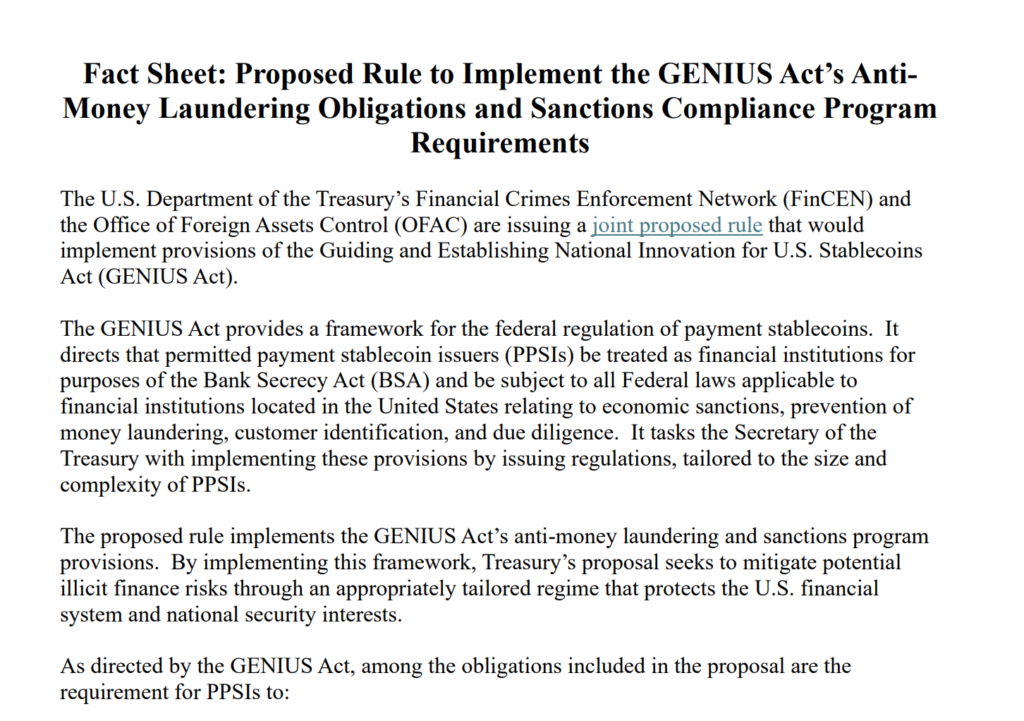
Under the proposal, stablecoin issuers in the United States would need to put in place robust anti-money laundering (AML) and countering the financing of terrorism (CFT) programs. They’d also maintain a dedicated sanctions compliance setup and gain the technical ability to block, freeze, or reject specific transactions when required.
In other words, these types of issuers will be categorized as financial institutions as per the Bank Secrecy Act (BSA).
Snir Levi, CEO of blockchain intelligence firm Nominis, says, “Bringing stablecoin issuers into full BSA/OFAC compliance effectively turns them into bank-like gatekeepers.”
That shift could mean more wallet freezes, transaction blocks, and asset seizures happening at scale across the ecosystem. For many in the industry, it’s a necessary evolution to build long-term trust and legitimacy, even if it adds operational layers.
Crypto Update two: Who is Satoshi?
Shifting gears in this crypto update, The New York Times dropped a detailed investigation that’s stirring up one of Bitcoin’s longest-running mysteries. The piece points to Adam Back, the respected British cryptographer best known for inventing Hashcash, as the most plausible candidate behind the Satoshi Nakamoto pseudonym.
Back has been quoted in the Bitcoin whitepaper, while the report draws attention to similarities between Back’s early work on electronic money, privacy technologies, and cypherpunk discussions and what Satoshi has mentioned in his writings.
However, Back immediately rejected those allegations and pointed journalists to a previous article on X where he explicitly denies being Satoshi. He stressed that his research and work have always been devoted to the benefits cryptography and electronic money systems could provide to society, adding that he had been an active participant since the early 1990s.
In addition, the investigation, which was conducted by John Carreyrou, the renowned investigative reporter who brought down the fraudulent company Theranos relies heavily on stylometry, an analysis of formatting peculiarities and technical terminology used by Satoshi.
This new endeavor to unveil Satoshi marks yet another episode in the crypto update story surrounding the mysterious origins of Bitcoin. We see just how much the early promoters of the protocol had an impact on its development, despite the identity of Satoshi still being unknown, many years down the road. Irrespective of whether or not the hypothesis proves to be true, it definitely keeps people talking.
On the price front, this crypto update captured a welcome rebound for Bitcoin. The flagship cryptocurrency climbed back above $72,000 for the first time in about 20 days, driven largely by easing geopolitical tensions. President Trump announced on Truth Social that he agreed to suspend bombing and attacks on Iran for two weeks, conditional on reopening the Strait of Hormuz to safe shipping. Iran’s Supreme National Security Council signaled acceptance of the ceasefire shortly after.
The Bitcoin price immediately reacted to the positive development by rising by about 2.6% in an hour and reaching as high as $72,339, as reported by CoinMarketCap.
Since the market usually views such political issues as a negative force on speculative investments such as cryptos, a signal that indicates that the situation is gradually stabilizing would trigger an upturn. In our crypto report, it appeared that the market reacted appropriately, which enhanced the sentiment level in the market.
Crypto update three from Switzerland
Another standout item in today’s crypto update is the launch of a live pilot for a regulated Digital Franc stablecoin system in Switzerland. A strong group of major banks, including UBS, PostFinance, Sygnum, Raiffeisen, Zürcher Kantonalbank, and BCV has teamed up with Swiss Stablecoin AG to test this initiative. The project functions as a secure sandbox environment running through 2026, letting participants experiment with stablecoin-based financial products without risking the wider system.
Transaction limits and restricted access help keep things contained, while the collaborative setup invites banks, companies, and institutions to work together toward building a more modern national digital payments infrastructure.
It’s a very practical move combining the experience in banking that Switzerland has gained in tandem with the advent of blockchain technology. This kind of move on the part of the crypto update indicates that the financial world recognizes the role of modern digital tools in its operations.
Crypto update four: Another Polymarket story
Rounding out this crypto update, prediction markets delivered another eye-catching story involving Polymarket. Three newly created wallets managed to turn a sharp eye on current events into substantial profits by betting on a US-Iran ceasefire by April 7, 2026. According to blockchain analytics from Lookonchain, the accounts collectively pocketed $484,575 after the market resolved positively following Trump’s announcement.
What raised eyebrows among on-chain observers was the timing and pattern. These wallets had zero prior activity before being funded and used on the day of the developments. One placed its initial “yes” bet around 1:59 pm UTC—roughly eight and a half hours before Trump’s Truth Social post at 10:32 pm UTC. The others entered earlier that day or even the night before, when the implied probability sat between just 2.9% and 10.3%. The payouts broke down to roughly $200,525 for one trader, $158,600 for another, and $125,450 for the third.
While prediction markets thrive on timely and accurate insights, these kinds of perfectly timed wins always spark questions about information edges. It’s not the first time Polymarket has seen notable results, and it adds an intriguing layer to how participants engage with fast-moving global events in the crypto update.
Overall, this week’s crypto update paints a picture of an industry maturing on multiple fronts: regulatory clarity gaining traction in the US, ongoing cultural fascination with Bitcoin’s roots, price sensitivity to world affairs, steady innovation in Europe, and the dynamic (sometimes controversial) nature of decentralized prediction tools. Each one has its own potential as well as things to consider for anyone participating in crypto.
In any event, the above helps demonstrate the need to always be on the lookout for what is happening and thinking critically. This principle applies whether the discussion is on regulations for stablecoins, which could turn the entire regulatory landscape upside down, or the return of Satoshi to the spotlight. All of the above helps account for the intrigue surrounding cryptocurrency.